Noise-to-Motion/#009/Post
Rank trackers are showing false drops. Check before you rewrite
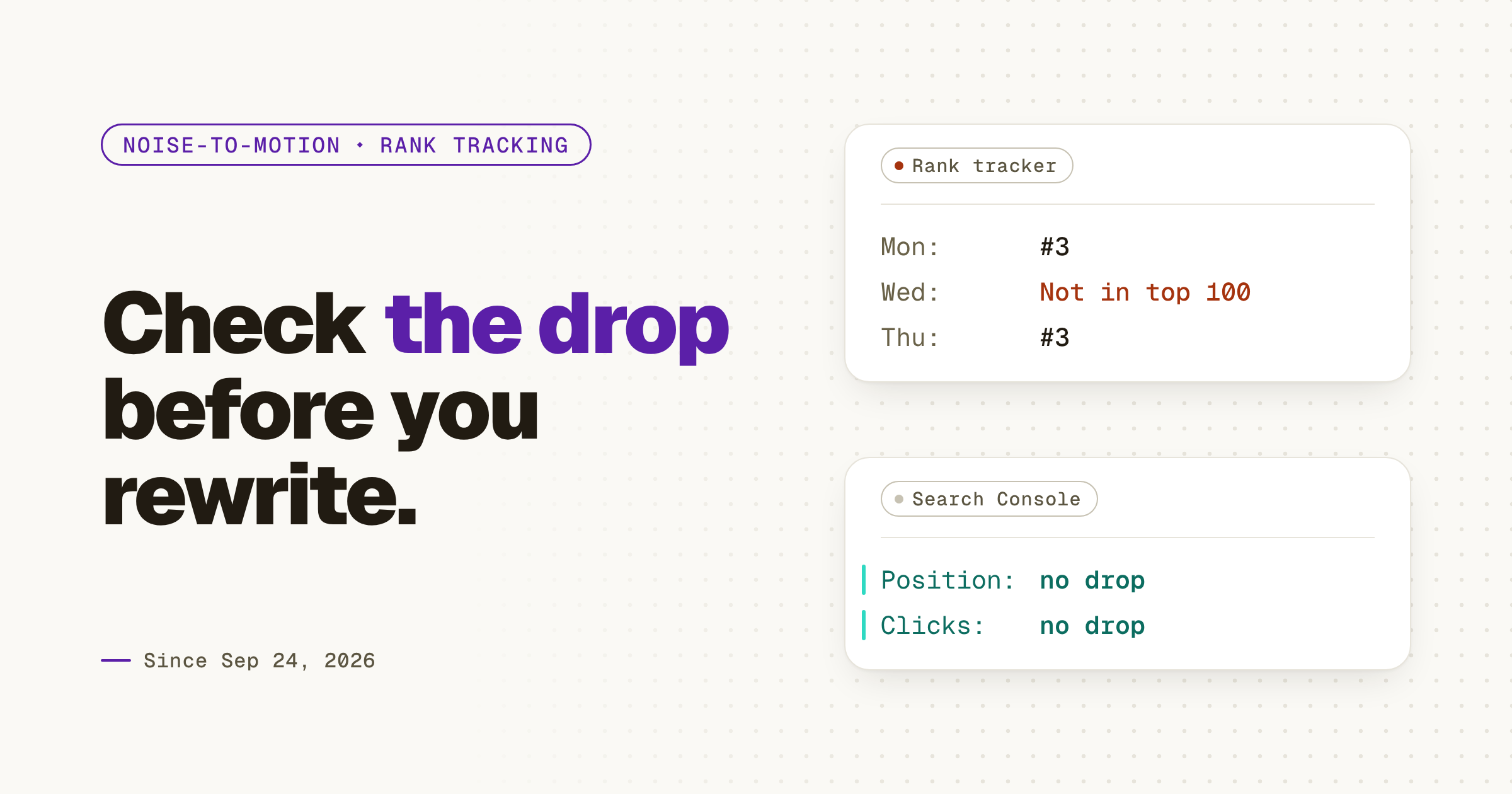
Since late September, Google has been feeding rank trackers swapped results pages, so a one-day drop in your tracker may be bad data: check Search Console before you rewrite the page.
01 ⬩ What shipped
Your rank tracker may be showing drops that didn't happen
AccuRanker published its numbers on Oct 19, 2026: since late September, Google has been serving rank trackers results pages that look normal but list a different set of sites, so a page that "fell out of the top 100" for a day is likely bad data, not a penalty. Before you rewrite a pricing or comparison page because a tracker says it dropped, check the drop against Google's own numbers.
AccuRanker calls them poisoned SERPs, and its write-up on the AccuRanker blog has the data. On September 25, the first day, 30.2% of desktop checks and 25.7% of mobile checks in its sample failed its consistency test. It got that under 2% within two days. Google tightened again on October 15, mostly on mobile, and Google has made no statement. Barry Schwartz has been collecting vendor statements in his Search Engine Roundtable story since Oct 12. Here's SE Ranking's note to its own customers.
02 ⬩ What it changes
A drop is a question until your own data agrees
On a small team, the tracker is often the only search report anyone reads, and a red arrow on Monday turns into a rewrite by Wednesday. That's the expensive mistake this month. The tracker is a reading Google never agreed to give; Search Console is the reading Google sends you about your own site. When they disagree, believe the one you own. AccuRanker's data says more than 9 in 10 runs of poisoned days last one day, and a fresh fetch comes back normal about 3 times in 4, so the drop to distrust is the one that's back the next morning. Semrush told Search Engine Roundtable the cases it still sees are "most often beyond the first page of results." Not every drop is fake, though. Glenn Gabe, the search consultant who's been comparing tools since September, has documented sites that really dropped and recovered after an unconfirmed Sep 4 update. His test works in both directions.
03 ⬩ What to do
Check the drop before you touch the page
AccuRanker's checklist is the right one, and you don't need AccuRanker to run it. Start with the pages that carry pipeline, because those are the ones a team rewrites in a hurry. It's the same split The Context Layer Is Not the Decision draws for company data: rent the outside reading, but act on what your own systems saw. Ask your vendor the last question on the list in writing. The answer tells you how much of last month's report to keep.
- 1Look at the next day. A drop out of the top 100 that's back tomorrow is most likely bad data.
- 2Check the rest of the page. If your usual competitors vanished the same day, suspect the data.
- 3Open Search Console and filter the Performance report by the same query and date.
- 4Read position and clicks. If neither fell that day, the tracker got a poisoned page.
- 5Ask your tracker how it detects poisoned pages and whether it re-checks a page before it reports it.
04 ⬩ Sources
Where this came from
- How AccuRanker Handles Poisoned SERPs, Peter Emil Tybirk, AccuRanker,
- Third-Party Google Rank Tracking Struggling Now, Barry Schwartz, Search Engine Roundtable,
- SE Ranking (@SERanking) on X,
- Glenn Gabe (@glenngabe) on X,
Get the next one the day it lands.Follow on LinkedIn