Noise-to-Motion/#008/Post
Meta's new terms let it crawl your site from Oct 30. Decide first
From October 30, a Meta business account authorizes Meta's crawlers to read the sites tied to your products, and the terms never mention robots.txt, so write your answer down first.
01 ⬩ What shipped
Meta changed the purpose, not the reach
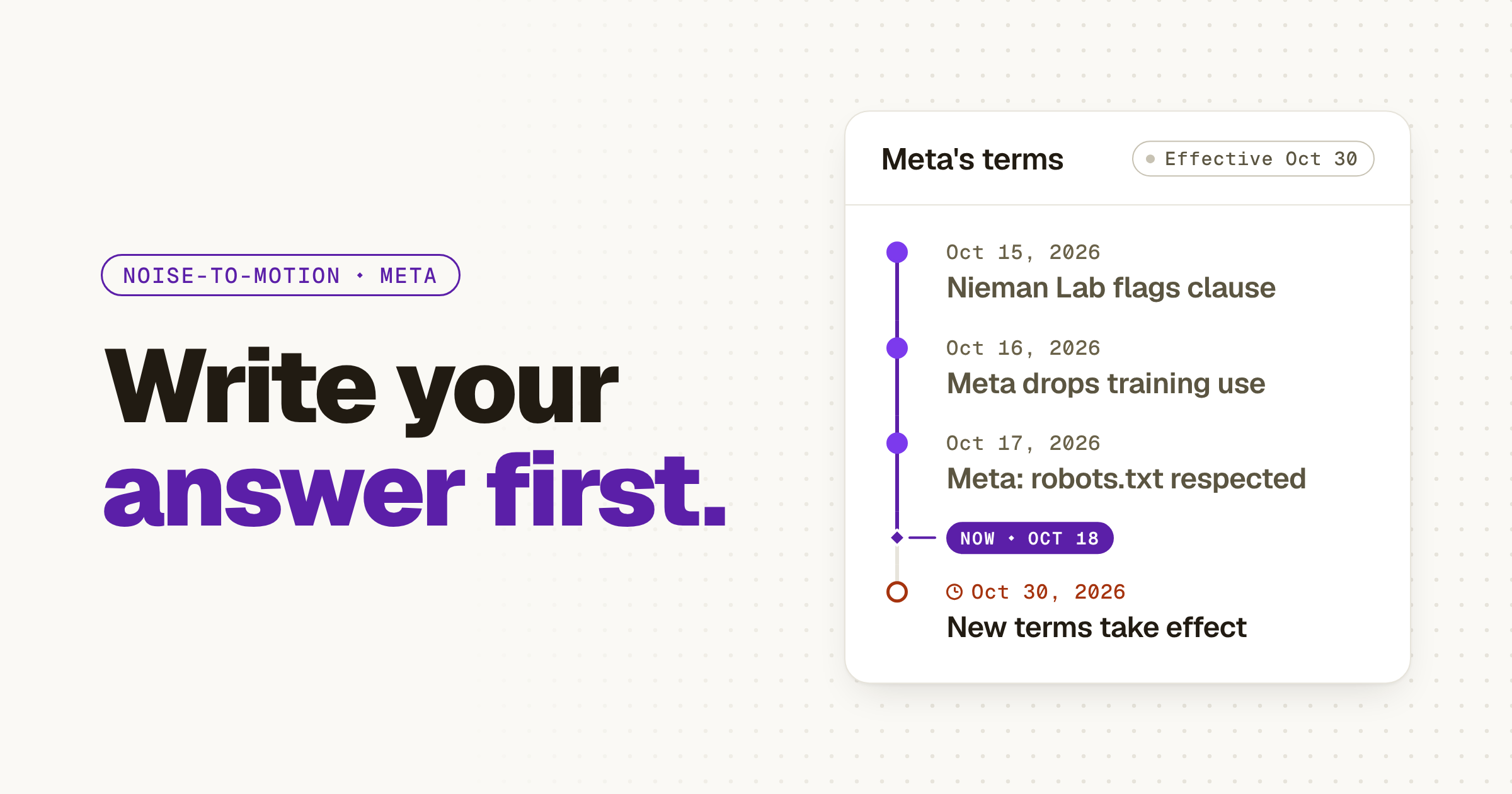
Meta's revised Commercial Terms take effect on October 30, 2026, and every company with a Meta business account agrees to them by staying on. They let Meta's crawlers read the sites tied to that company's products. My read: Meta narrowed what it can do with your pages, not which pages it can read, and if you run Meta ads, your landing pages are in scope.
The clause sits in Meta's own preview of the terms. It authorizes Meta to "crawl the domains, web pages, or URLs (and any content available through them) that are associated with your products or services." The first draft let Meta use that content to train its products. The version Meta revised on Oct 16 drops training and limits the use to Meta's ads and business products. A Meta spokesperson told Nieman Lab that robots.txt preferences are still respected. Nieman Lab read the new text and found that "Meta has not included any specific language about respecting robots.txt preferences in its revised terms of services."
Glenn Gabe, a search consultant who reads these changes through client work, posted Meta's statement on Oct 18.
02 ⬩ What it changes
Your robots.txt is the only record
On October 30, every company with a Meta business account will have agreed to the crawling clause, whether anyone on the team read it or not. The coverage so far is about news publishers, which makes sense, since Nieman Lab is one. A B2B software company has the same account for its ads, and its pricing page, its docs and its changelog are about as tied to its products as pages get.
The terms say what Meta may read. They don't say what you said back. The one place your answer lives is robots.txt, and Benjamin Sobel, a law professor at the University of Wisconsin, told Nieman Lab it states a preference, not a right. So write it on purpose, and keep the date you wrote it. It's the same rule as on by default not being approved by default: the account came with an answer, and it wasn't yours.
Gabe flagged the date the morning after Nieman Lab's first story ran.
03 ⬩ What to do
Write your answer before October 30
Start with the list. Every domain your Meta ads and Pages link to is a domain Meta can call associated with your products, so write them all down, including the old campaign subdomain nobody has touched in a year. Then read the crawling clause in Meta's preview once, all the way through.
Decide which of those pages Meta's crawlers may read, put that in robots.txt, and save Meta's statement to Nieman Lab beside the change. Nieman Lab reports there's no way for a business account to opt out before the date, so the rule you write is the answer you'll have on the 30th.
- 1List every domain your Meta ads and Pages link to.
- 2Read the crawling clause in Meta's terms preview.
- 3Decide which pages Meta may read and write it in robots.txt.
- 4Save Meta's statement beside the change, with the date.
04 ⬩ Sources
Where this came from
Get the next one the day it lands.Follow on LinkedIn