
On Tuesday, with Dreamforce and UNBOUND under way, Chris walked one account across six tools. A prospect at a target account visits pricing three times in a week. Two people from the same company are active in a trial. The account is already in the CRM with a stale owner. The team expects an alert in Slack, follow-up through the outbound tool, and a row in the warehouse. His question was who is allowed to act across those systems, and where anyone can review the whole sequence.
Brad has spent three weeks on a different question about the same kind of account: not which tool a signal landed in, but which class it belongs to and who owns the instrument. Four classes: product behavior, anonymous site intent, CRM lifecycle, ecosystem exhaust. So far, the class you own, the class you rent, and on Wednesday, the class you filed.
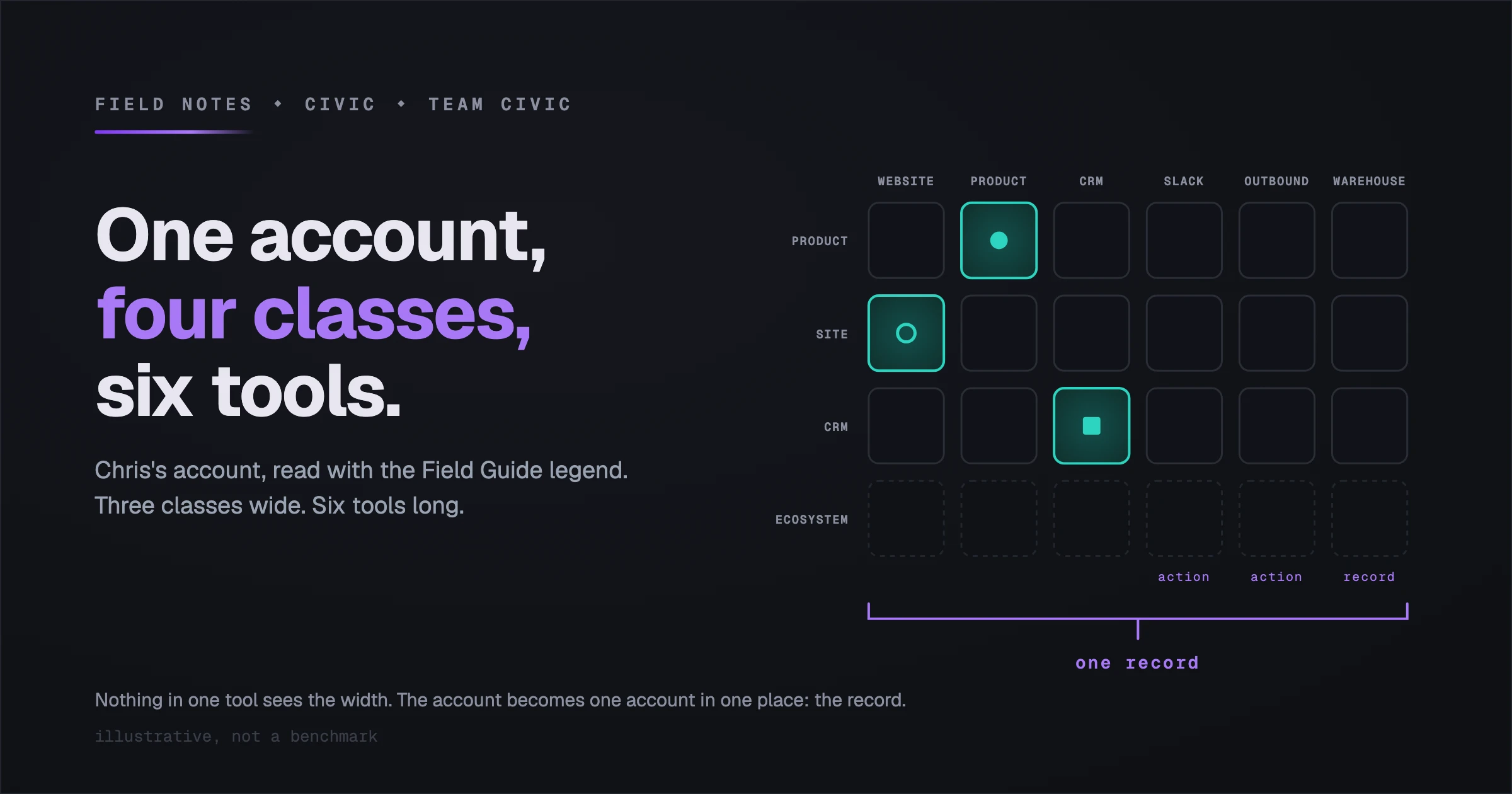
Put the two together and Chris's account reads differently. Only three of the six tools hold a signal. And the account is one account in exactly one place, which is not any of the six.
Label the touches
Take the touches in Chris's order. The account is anonymized as Anweledig Labs, and every value below is illustrative.
Pricing three times in a week. Site intent: pricing → return → repeat (7d), in the notation Brad uses and Bryn logs. The visits happened on your surface. The company name attached to them did not; an identity vendor matched a cookie or an IP address to an organization, so this touch is resolved, not known. Rented, in part 2's word.
Two people from the same company active in a trial. Product behavior: trial → second seat → both active (7d). Two humans using the product with their hands, inside a surface you run. Nobody can reprice this signal or sell it to the company you lost a deal to last month. Owned, part 1.
Already in the CRM with a stale owner. CRM lifecycle: a lead filed fourteen months ago, owner long gone, no activity logged since. Alone, that is a filing. Joined to the pricing visits it becomes filed lead → pricing return (14mo), a specimen. The record is yours; the enrichment on it and most of the activity log around it usually are not. Yours on paper, Wednesday's phrase.
Then Slack, the outbound tool, and the warehouse. No signal lives in any of them for this account. Slack is where the alert lands, the sequencer is where the follow-up runs, the warehouse is where the row goes. Labelling them as action and record surfaces is most of the work, because a dashboard treats all six as sources.
Select a tool. The panel shows the touch on this account, its Field Guide class, who owns the instrument, and the line Bryn writes for it. Arrow keys move between tools.
| Tool | Touch on this account | Class | Who owns the instrument | Bryn's line |
|---|---|---|---|---|
| Website | A prospect at the account visits pricing three times inside a week. | Site intent: pricing → return → repeat (7d) | Rented. The visits are on your surface; the company name came from an identity vendor's match. | I matched pricing → return → repeat (7d) on Anweledig Labs at 09:41:06Z. Resolved to company by the identity vendor. No person named. |
| Product | Two people from the same company are active in a trial workspace this week. | Product behavior: trial → second seat → both active (7d) | Owned. Nobody can reprice it, degrade it, or sell it to a competitor. | I matched trial → second seat → both active (7d): two users on the Anweledig Labs trial, both active this week. Owned signal. It carries the weight. |
| CRM | Already in the CRM: a lead filed fourteen months ago, owner moved on, no activity logged since. | CRM lifecycle: filed lead → pricing return (14mo) | Yours on paper. The record is yours; the enrichment on it and most of the activity log usually are not. | I read the filed record: lead, created 2025-07, owner inactive, no touch logged. Joined it to the pricing return as filed lead → pricing return (14mo). |
| Slack | The team expects the alert here. | Action surface (no signal lives here for this account) | Your channel; Slack's log. | I posted to #growth-signals: the three visits, the two seats, the filed record, the score by axis. One message, evidence attached. 09:41:09Z. |
| Outbound | Follow-up runs through the sequencer. | Action surface | Your sequence; the sequencer's log. | I held enrollment in trial-expansion-v2 for approval. op_2 approved in 2m14s. Enrolled the trial admin at 09:43:21Z. What the sequencer does next is in the sequencer's log. |
| Warehouse | Reporting lives here. | Record surface | Your table; fed by the record. | I wrote run_7a31c9 to the audit log. The export carries it to your warehouse as one row. Another person can reconstruct the run from that row alone. |
A prospect at the account visits pricing three times inside a week.
pricing → return → repeat (7d)
who owns the instrument rented: the visits are on your surface; the company name came from an identity vendor's match
Resolved, not known. The vendor matched a cookie or an IP address to an organization and named no person. Part 2's class: good fidelity, and a lease worth reading.
⬩ Bryn  09:41:06Z
I matched pricing → return → repeat (7d) on Anweledig Labs. Resolved to company by the identity vendor. No person named.
Illustrative, not a benchmark. Account anonymized. Tool order is Chris's from Tuesday. Class labels and the ownership axis are Brad's from Signals: A Field Guide.
Figure 1. Six tools, one account. Select a tool to see the touch, its Field Guide class, who owns the instrument, and the line Bryn writes for it (illustrative, not a benchmark).
Three wide, six long
So the account is three classes wide and six tools long. Nothing that lives inside one tool sees the width.
An agent inside the CRM reads the filed class well, plus whatever the CRM has been told. If the trial activity syncs in as a field, it sees a field. If the pricing visits arrive as a lead-score bump, it sees a bump, without the parts. It can act inside the CRM, and act competently. What it cannot see is that the two seats and the three visits are the same week on the same account, unless something else did the join first. That is not a knock on the agent. It is the shape of living in one column.
Chris's test on Tuesday was whether you can control and review the full cross-tool workflow, or only what happens inside one platform. Brad's legend asks which class a signal is and who owns the instrument. Same question, asked from two ends: one starts at the actions and works back to the signals, the other starts at the signals and works forward to who may act on them. Both arrive at the join.
This account's three touches are lit. Choose an operating model to see what it can read and act on.
| Class | Website | Product | CRM | Slack | Outbound | Warehouse |
|---|---|---|---|---|---|---|
| Product behaviorowned | 2 seats (7d) (outside the CRM column; not read by this model) |
|||||
| Site intentrented | 3 visits (7d) (outside the CRM column; not read by this model) |
|||||
| CRM lifecycleyours on paper | filed lead (14mo) (in reach: inside the CRM column) |
|||||
| Ecosystem exhaustnone this week | ||||||
| The Playactions and record | task to owner (runs inside the CRM) | post (not reachable by this model) | enroll (not reachable by this model) | one row (no cross-tool record in this model) | ||
| Record | one record |
|||||
Agent inside the CRM. On this account it reads one lit cell, the filed lead, plus whatever was synced into the CRM as fields. The three pricing visits and the two trial seats sit outside its column. It can open the task for the on-duty owner inside the CRM, and its record stays inside the CRM.
One approved workflow across the stack. It reads all three lit cells on one account: the visits, the seats, and the filed lead. It scores them together, runs the post in Slack, the task for the on-duty owner in the CRM, and the enrollment in the sequencer, and writes one record that lands in the warehouse as one row.
Illustrative, not a benchmark. Rows are the four Field Guide classes; columns are Chris's six tools. The fourth row is empty for this account this week; part 4 of the Field Guide is next week.
Figure 2. Four classes by six tools, with this account's three touches lit. Switch between an agent inside the CRM and one approved workflow across the stack (illustrative, not a benchmark).
 I matched