Noise-to-Motion/#022/Post
Sistrix: your AI prompt list flatters you. Widen it, run it weekly
Sistrix's study of 10,826 measurement series says a short list of prompts you check every day mostly measures noise and your own choices, so ask more questions, less often.
01 ⬩ What shipped
Sistrix tested how to measure AI visibility, and breadth won
Sistrix, which sells search and AI visibility tracking, published a study on Oct 28, 2026 of 10,826 daily measurement series across four AI models and eight countries, and found that 20 different prompts asked once are more than three times as accurate as one prompt asked on 20 days. My read: a short prompt list you check every morning is mostly measuring luck and the person who wrote the list.
AI visibility here means how often AI answers mention your brand. The write-up, Measuring AI visibility: why breadth beats repetition by Johannes Beus of Sistrix, starts with a prompt Sistrix asks ChatGPT every day: which robot vacuum is currently the best. Over four weeks, Ecovacs appears on 12 of 28 days, Mova on 11 and Xiaomi on 3, with no discernible pattern. Across the whole dataset, 70% of the brands that appear in a prompt's answers show up on fewer than one in five days, and only 6% on at least four of five. Sistrix says that holds for ChatGPT, AI Overviews, AI Mode and Perplexity alike. Glenn Gabe, who reads Google ranking changes through his client work, pulled out the line that matters for anyone with a daily check.
02 ⬩ What it changes
Twenty prompts once beat one prompt twenty times
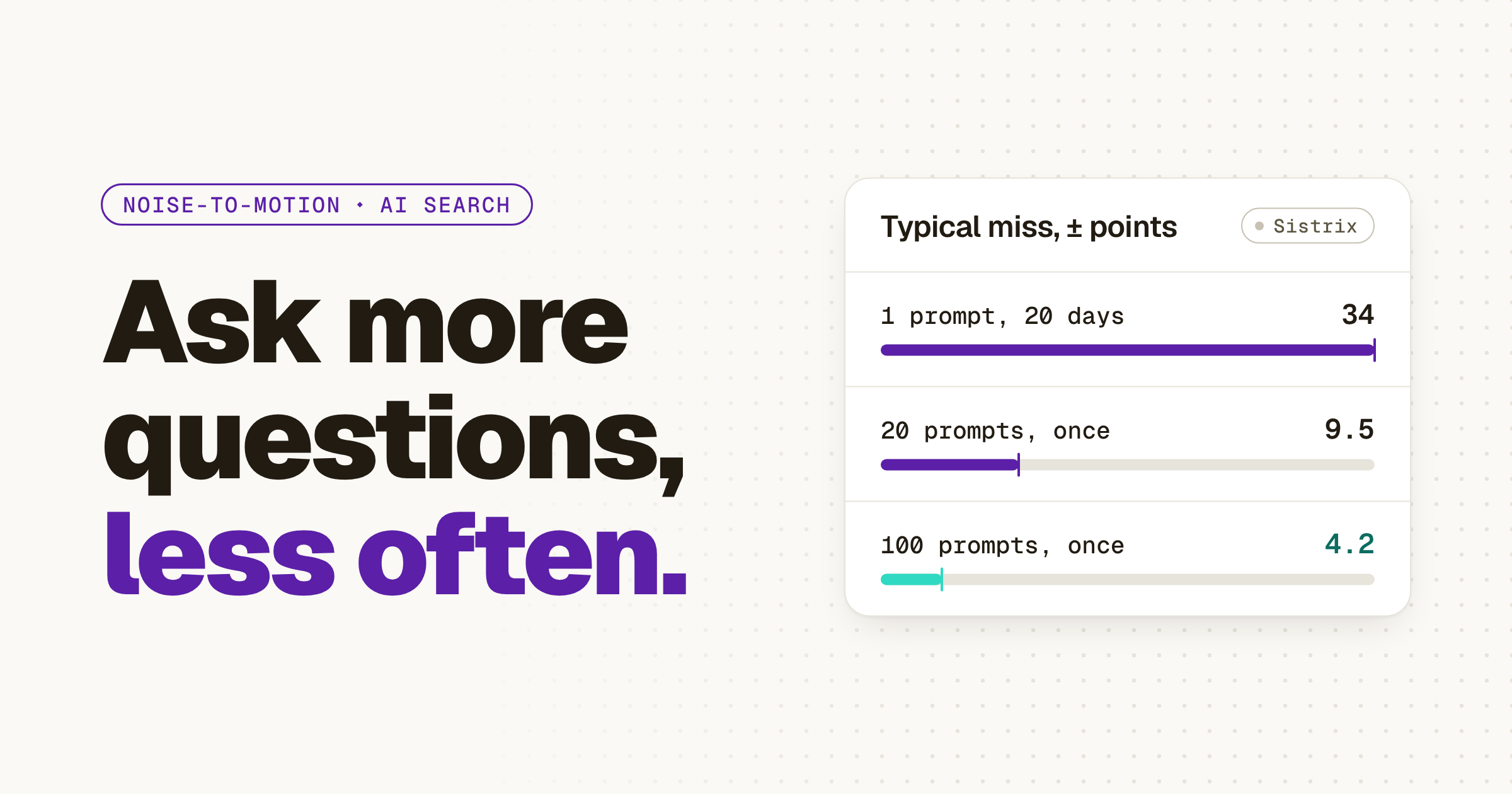
Sistrix framed it as a budget of 20 queries. Take a brand that really appears in 25% of answers. Ask one prompt on 20 days and your reading could land anywhere from 0 to 59%. Ask 20 different prompts once and it falls between 16 and 35%. With 100 prompts, it's 21 to 29%. The reason is that prompts differ from each other far more than one prompt differs from day to day, 2.4 times as much on average, and repeating a prompt only smooths the smaller wobble. So Sistrix would rather you ask 100 prompts weekly than 15 prompts daily, for about the same effort.
The second finding is the one I'd act on first. Sistrix compared brands' visibility in prompt sets they picked themselves with their visibility across its own market-wide pool of prompts. In three of four cases, the brand looked better in its own set, usually by a clear margin. Sistrix calls it a selection effect: you write questions that sit close to your brand. If your prompt list and your positioning came from the same person, the list will agree with the positioning.
03 ⬩ The counter
iPullRank says there's no true number to hit
Mike King, founder and CEO of the search agency iPullRank, argued on Sep 17, 2026 in There Is No “Accuracy” in AI Search Tracking: Only Precision that asking whether a tracker is accurate is a category error, because there is no single true answer to measure against. Sistrix answers him by name: define the true value as the mention rate across all prompts in a market, and accuracy becomes measurable, and it turns out to be the bigger source of error. It does grant King that repetition has a use: it tells you whether something changed, not how visible you are. King's most useful point for a small team is where the real numbers live: referral traffic from AI answers, crawler hits in your server logs, and deals where a buyer says they heard about you in ChatGPT. When visibility climbs and those don't, he says, the tracker is measuring something that isn't tied to your business. That's the buyer the Field Note Your Buyer's AI Does the Research. Be Ready When a Person Comes to Verify It. is about.
04 ⬩ What to do
Ask more questions, less often
Sistrix closes on five recommendations, and three of them need no new tool. Go wide first: 20 prompts give a rough estimate within ±10 points, around 70 get you to ±5, and around 200 to ±3. Run the big set weekly, not daily: 140 prompts once a week are accurate to ±3.6 points, while 20 prompts a day on a 7-day average only reach ±7.9. Judge any change on weekly averages, because daily values jump by 5 to 10 points for no reason. The other two point to Sistrix's own market-wide tracker, the AI Check, which is worth knowing as you weigh them. The cheap version for a small team is to write the new prompts the way a buyer asks before they know your name, and keep the brand-heavy ones as a separate set for spotting change.
- 1Go wide. About 70 different prompts for a reading within ±5 points.
- 2Run it weekly. A big set once a week beats a small set every day.
- 3Compare weekly averages. Daily values jump 5 to 10 points on their own.
- 4Read rivals with care. In your own set, competitors sit at the margins and swing more.
05 ⬩ Sources
Where this came from
Get the next one the day it lands.Follow on LinkedIn