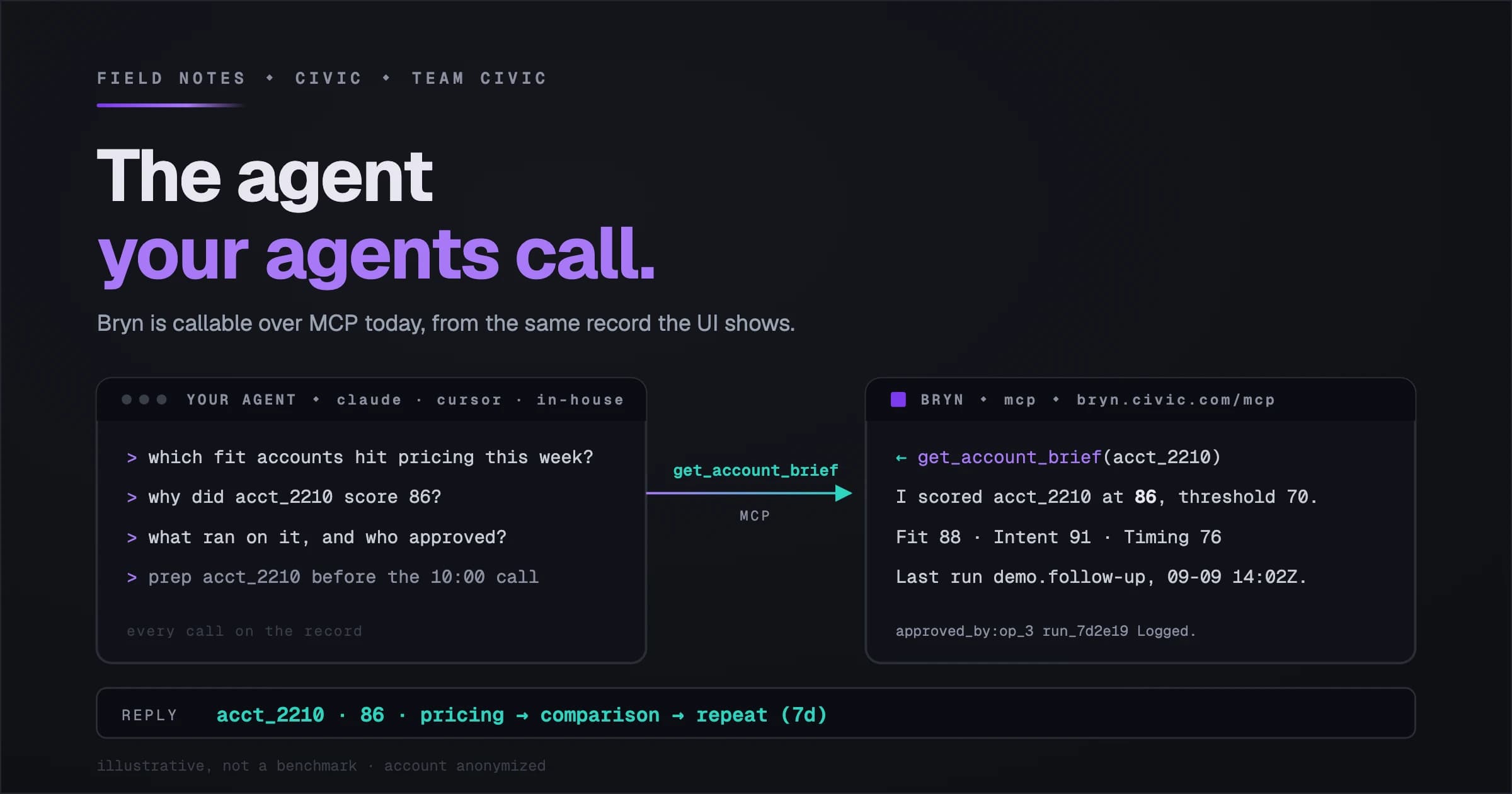
Dreamforce and UNBOUND open this week on the same idea: the agent lives inside the platform. Bryn is already the agent your agents call. Over MCP, a Claude, Cursor, or in-house agent can ask who is on your site from a fit account, why an account scored what it did, what ran on it and who approved, and hand Bryn a Play to install, with every answer drawn from the same record the UI shows. That is live today. Next, Bryn is learning to read a company the way a buyer does. Yours first.
Civic Team, Staff
||14 min read|
tl;dr
Dreamforce and UNBOUND open this week on one idea: the agent lives inside the platform. Bryn is already the agent your agents call. Over MCP, a Claude, Cursor, or in-house agent can ask who is on your site from a fit account this week, why an account scored what it scored, what ran on it and who approved, and hand Bryn a Play to install from your catalogue, and every answer comes back with its parts from the same record the UI shows. That is live today. Next, Bryn is learning to read a company the way a buyer does. Yours first.
Dreamforce runs September 15 to 17 in San Francisco. UNBOUND runs September 16 to 18 in Boston. The headline product at both will be the agent inside the platform, and the rest of the category has been building toward the same stage. HubSpot's Agent CLI, now in public beta, is a command-line interface built for agents rather than people to operate the CRM (HubSpot Developer Changelog, Jun 23, 2026). Outreach made its MCP server generally available with a Claude connector in February (Business Wire, Feb 24, 2026) and put its app in ChatGPT in June (Business Wire, Jun 3, 2026). 6sense piped intent into anyone's agent in August, which we wrote up as Intelligence Became an Ingredient.
All reasonable things to build. They leave one question open: where does the agent live when your pipeline runs across six tools and none of them is the platform? Our answer is somewhere the other agents can call.
The third surface
In August a founder described our architecture back to us on a feedback call, unprompted, for his own product: software now lives on three surfaces at once, the tool's UI, the agent inside the tool, and the agent outside it reaching in over MCP. Most of what gets announced this week is surface two. Bryn already has surface three.
"Callable" does a lot of work in launch posts, so here is what it means in practice. Bryn exposes an MCP server (docs). You copy a tenant-specific URL from the dashboard, your client signs in through Civic Auth, and whatever agent you already run, Claude Desktop, Cursor, VS Code, an internal bot, sees Bryn's tools. Your agent can then ask Bryn for:
the accounts on your site this week that fit your profile, ranked highest intent first, filtered by a signal or a minimum score (search_entities)
why an account scored what it scored, broken down by Fit, Intent, and Timing with the signals that contributed, from the same score data the dashboard shows (explain_score)
one account's brief: firmographics, last score, recent signals, recent Play runs (get_account_brief)
what ran on an account, who approved it, and when, from the append-only log, newest first (query_audit_log)
the Plays you have, the catalogue you can install from, and an install (list_plays, list_play_catalogue, install_play)
Two properties matter more than the list. The answers come back with their parts: the pattern by its steps, the score by its axes, the run with its approver. And nothing an agent does over MCP is off the record. The call is a line in the same log the UI reads, under the same membership that lets you into the workspace.
Ask Bryn what your agent would ask.
Four questions, in plain language. Each shows the tool the ask maps to and Bryn's reply, in its own record register, on one anonymized account.
ask 1 of 4search_entitiessignalType:pricing minComposite:70
YOUR AGENTWho is on my site from a fit account this week?
BRYNThree accounts above 70 carried pricing in the last 7 days.Top: acct_2210 (Anweledig Labs), 86, pricing → comparison → repeat (7d).Then acct_1187, 79, pricing ×2 (7d). Then acct_3402, 72, pricing → docs (7d).Ranked highest intent first, from the same list the dashboard shows.
Accounts, ranked, with the pattern on each. The agent gets the list the UI shows, not a summary of it. (illustrative, not a benchmark)
All values illustrative, not a benchmark. Account anonymized. Tool names are the live connector's; replies show the shape of what comes back, not a transcript.
Figure 1. Four questions an agent can put to Bryn today, the tool each maps to, and the reply in Bryn's record register (illustrative, not a benchmark).
What that changes
Pipeline review moves to wherever you already are. A growth owner opens a Claude session on Monday morning and asks which fit accounts carried pricing this week, why the top one scored what it did, and what ran on it. The answers arrive with their parts, and the decision that follows (approve the held run, or leave it) is the same decision the UI would have asked for.
An in-house agent can pull the account brief before a call and drop it into the prep. Here is the shape of what it gets back.
Figure 2. An account brief as get_account_brief returns it today: account, score by axis, the pattern by its parts, recent signals, last Play run, record id (illustrative, not a benchmark).
Governance carries over rather than thinning out. The agent signs in through the same Civic Auth membership that governs the UI, so it sees your workspace and nobody else's. When it asks Bryn to install a Play, it can only pick from your catalogue, the title comes from the catalogue and not from the caller, and the Play runs under the mode you set. In Approve mode, every matching run holds for a human click, whether a person or an agent asked for the Play. Every call lands in the log. We wrote in Bounded Autonomy Is the Spec that the boundary, the approval, and the record are what to demand from any agent before you hand it a channel. Putting your own agent in front of Bryn adds nothing to that list and removes nothing from it.
BRYN byCivicLabor Day offer ⬩ through September 17
Save Your Labor (Day)
Bryn watches your site, scores the account, runs the Play, and files the run. A free month of it, on any tier.
Timesheet ⬩ arbor.devPunched ⬩ Tue 2:02 PM
2:02:08 PMWatched a return to pricing, then the comparison page
2:02:09 PMScored the account 86
2:02:10 PMRan the pricing.follow-up Play into Slack and the CRM
That is step one, and it is live today on every tier. Step two is the only forward-looking sentence in this piece:
Bryn is learning to read a company the way a buyer does. Yours first.
Here is what the sentence means. A buyer evaluating a vendor does not read the homepage. They read the pricing page, the docs, the integrations list, the changelog, the careers page, and the comparison pages, and from those they form a view of what the company actually sells, how fast it ships, who it is hiring, and whether it fits. Brad wrote in July about what happens when the buyer sends an agent to do that read. This is the mirror image. Bryn is being taught to do the same read, for discovery, deep research, prep, and pre-sales.
It starts with your company because a brief about a prospect is only useful relative to what you sell. "They are hiring for growth" means one thing to a sales-tooling company and another to a payroll company. Before Bryn can say why a prospect fits, it has to know what fit means for you, from your own pages rather than from a form you filled in once.
What a buyer reads. What Bryn will read for.
Six pages a buyer evaluating a vendor actually reads. Pick one to see what a buyer infers from it today, and what Bryn will read it for.
1 of 6Pricing
What a buyer infers
Who the product is for, how it is sold (seats, usage, flat), where the ceiling is, and what "contact sales" is hiding.
What Bryn will read for
Your buying unit and price ladder, so a prospect's plan and tier will map onto what you actually sell.
illustrative; a step in progress, no date
Illustrative. The right column describes a step in progress, in the future tense, with no date attached.
Figure 3. Six things a buyer reads about a company, what a buyer infers from each, and what Bryn will read them for (illustrative).
What does not change
The loop we laid out in July in What Bryn Actually Does: watch, score, run, log. The two modes, Run and Approve, and the kill switch behind them. The record. The read Bryn is learning becomes another input to the score and to the brief, not a new authority. It does not get to send anything, and it does not get to skip the Play. A better-informed score still clears the same threshold, still runs the same approved Play, and still writes the same line.
Then, now, next.
Three steps. Two are live. The third is in progress and carries no date.
step 1 of 3Since launchLIVEJuly 2026
BRYN
I watched pricing → comparison → repeat (7d) on acct_2210, scored 86, ran demo.follow-up, logged run_7d2e19.
Bryn watches, scores, runs, logs. Run mode by default; Approve mode holds each run for one click; the kill switch suspends everything and logs the suspend. (illustrative)
1 / 3
Illustrative. Step 3 shows no date. Auto-advance is off by default and is not offered when your system asks for reduced motion.
Figure 4. What Bryn has done since launch, what your agents can do with it today, and the step in progress. No date on step 3 (illustrative).
Bryn is not another dashboard to watch. It is the governed execution layer that runs Plays through your stack.
Do this Monday
Point one agent you already run at Bryn's MCP endpoint. Claude Desktop, Cursor, an internal bot: the setup is a URL and a sign-in (docs). Then ask it three questions in plain language.
Who from a fit account was on our pricing page this week? Why did that account score what it scored? What ran on it, and who approved?
If the answers come back with their parts (the pattern, the score by axis, the record line with an approver on it), you have an agent your agents can call. If they come back as a summary, or do not come back at all, you have found the gap, and you found it before Q4 did.
Our team brings decades of experience across the domains that matter: 10 years in AI and agentic systems, 65 in financial services, 35 in identity and access management, 30 in marketing and AdTech, 15 in legal and professional services, and 12 in manufacturing and industrial.
We're for operators who can't afford unintended actions or silent failures, and who want the agent in production quickly and effectively.