
Field Notes/bryngtmagentsgovernanceaudit

Thirteen Agents, One Owner

Salesforce's Agentic Enterprise Index puts the average agent fleet at 13, up from 5 a year and a half earlier. Building an agent got 53 percent faster. Governing one did not. Three verbs tell you if your fleet is run or just running.

Civic Team
Civic Team, Staff
3 min read
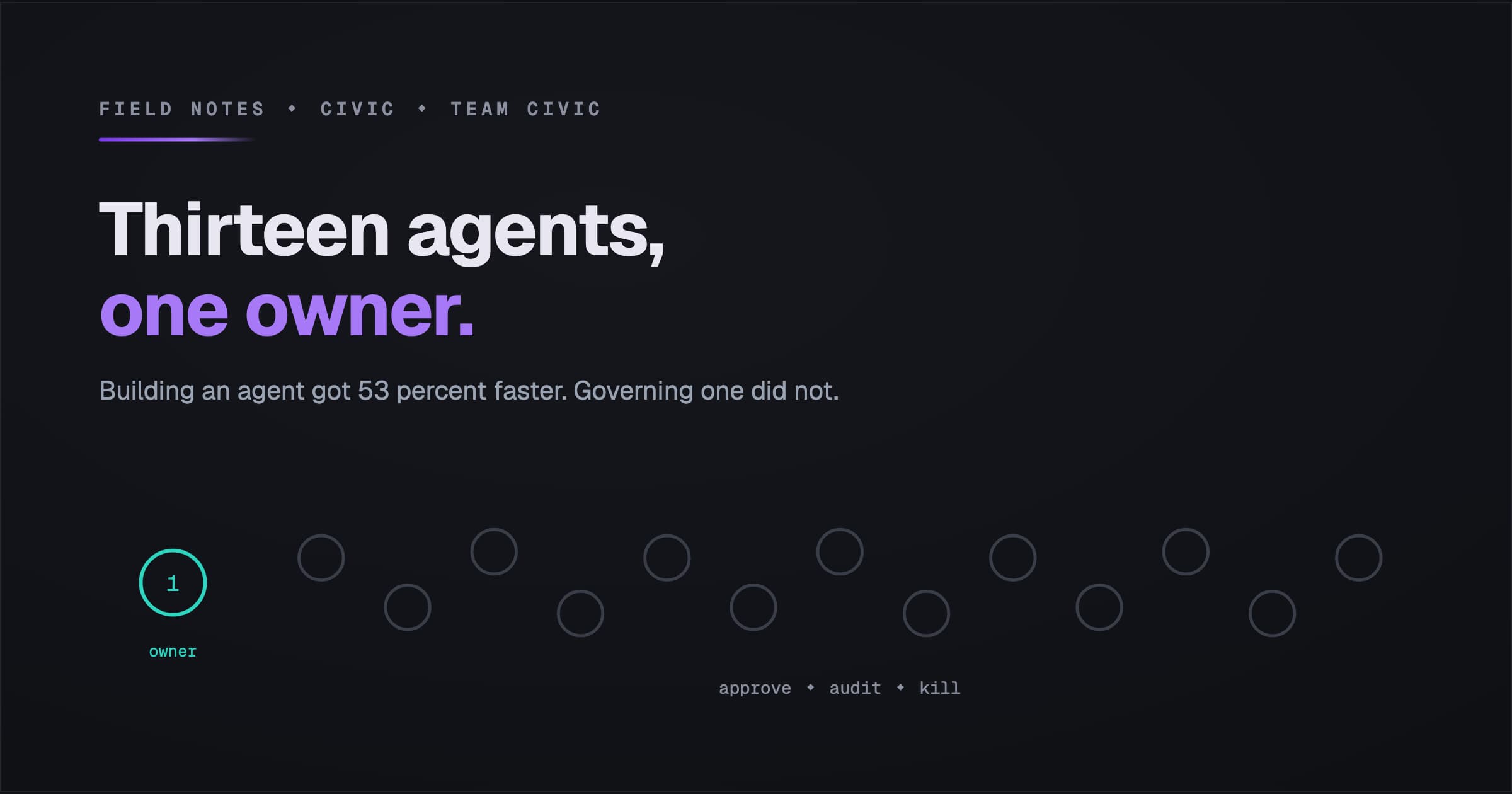
Title card: Thirteen Agents, One Owner. Thirteen small agent marks, one highlighted owner mark.
tl;dr

Salesforce's Agentic Enterprise Index puts the average agent fleet at 13, up from 5 in early 2025. Building an agent is now a 1.9-day job, down 53 percent. Governing one is not faster at all. Before the fleet grows again, every agent needs an answer to three verbs: who approved it, who audits it, who can kill it.

Salesforce published the second edition of its Agentic Enterprise Index in August. Drawn from usage of its own platform across thousands of businesses, so read it as a view from one large vendor's window, but the direction is hard to argue with: the average organization ran 5 activated agents in February 2025 and runs 13 as of April 2026. Creating an agent now takes 1.9 days on average, down 53 percent.

Read those two numbers together and a third number is missing. Agent count nearly tripled. Creation time halved. Nothing in the index says governance capacity moved at all.

What got easier was never the constraint

Configuring an agent was always the cheap part, and it is getting cheaper every quarter. The expensive part is what comes after: someone has to own the thing.

An owned agent has answers to three verbs.

Approve. Who decided this agent's action set was allowed? Not who built it. Who signed off on what it is permitted to do, and where is that decision written down?

Audit. Where is the record of what it actually did? Not the dashboard of outcomes. The log: what it saw, why it acted, what it touched.

Kill. Who can stop it today, without filing a ticket, and how fast?

At 5 agents, a team can carry those answers in someone's head. At 13, heads stop scaling. The failure mode is quiet: thirteen agents, one part-time owner, zero shared record. The fleet works fine right up until the week something goes wrong, and then nobody can reconstruct what happened or turn off the right thing.

The twenty-minute inventory

Here is the Monday exercise. List every agent running anywhere in your stack, including the ones inside other products. For each, fill three cells: approver, audit surface, kill switch.

Your agent inventory

Copy this table and fill it in:

AgentApprover (who signed off on its action set)Audit surface (where the log lives)Kill switch (who can stop it today)


Example rows are illustrative, not a benchmark.

The count is not the finding. The blanks are. A team running 4 agents with twelve filled cells is in better shape than a team running 13 with thirty blank ones. Blank cells are governance debt, and like the other kind of debt, the interest compounds quietly.

A FLEET OF THIRTEEN, MAPPED AGAINST THREE VERBS The count is not the finding. The blanks are. approveauditkill support triagelead researchmeeting notes invoice matchchurn flagscontent drafts data hygienerenewals nudgeqa sampler inbox sortenrichmentpricing watch outbound draft namedlogged1 click namedlogged named1 click loggednamed 1 click GOVERNANCE DEBT Every dashed cell is a question nobody can answer on the day it matters. Example fleet (illustrative, not a benchmark). Fleet size from Salesforce's Agentic Enterprise Index, August 2026.
A fleet of thirteen, mapped (illustrative, not a benchmark).
BRYNbyCivic Running now

What would this essay do if it could act? It just did.

Essay, alone

Someone reads it. Maybe they fit your ICP. The minute passes and nobody downstream ever knows.

Your chance to reach your engaged, identified prospect: Gone

Every run lands on the record.

One agent, three verbs answered

This is the shape we think agent adoption has to take, and it is how Bryn is built. Plays are approved before they ever run, so the approve verb has a written answer by construction. Every action lands in the audit log: what Bryn saw, why it acted, what it did. And kill is a first-class mode, not a support ticket.

Bryn is not another dashboard to watch. It is the governed execution layer that runs Plays through your stack. One agent with three verbs answered will beat thirteen with none, every week that matters.

Stop watching signals. Start running them.

Civic Team

Civic Team

Staff

More essays by Civic

Our team brings decades of experience across the domains that matter: 10 years in AI and agentic systems, 65 in financial services, 35 in identity and access management, 30 in marketing and AdTech, 15 in legal and professional services, and 12 in manufacturing and industrial.

We're for operators who can't afford unintended actions or silent failures, and who want the agent in production quickly and effectively.