
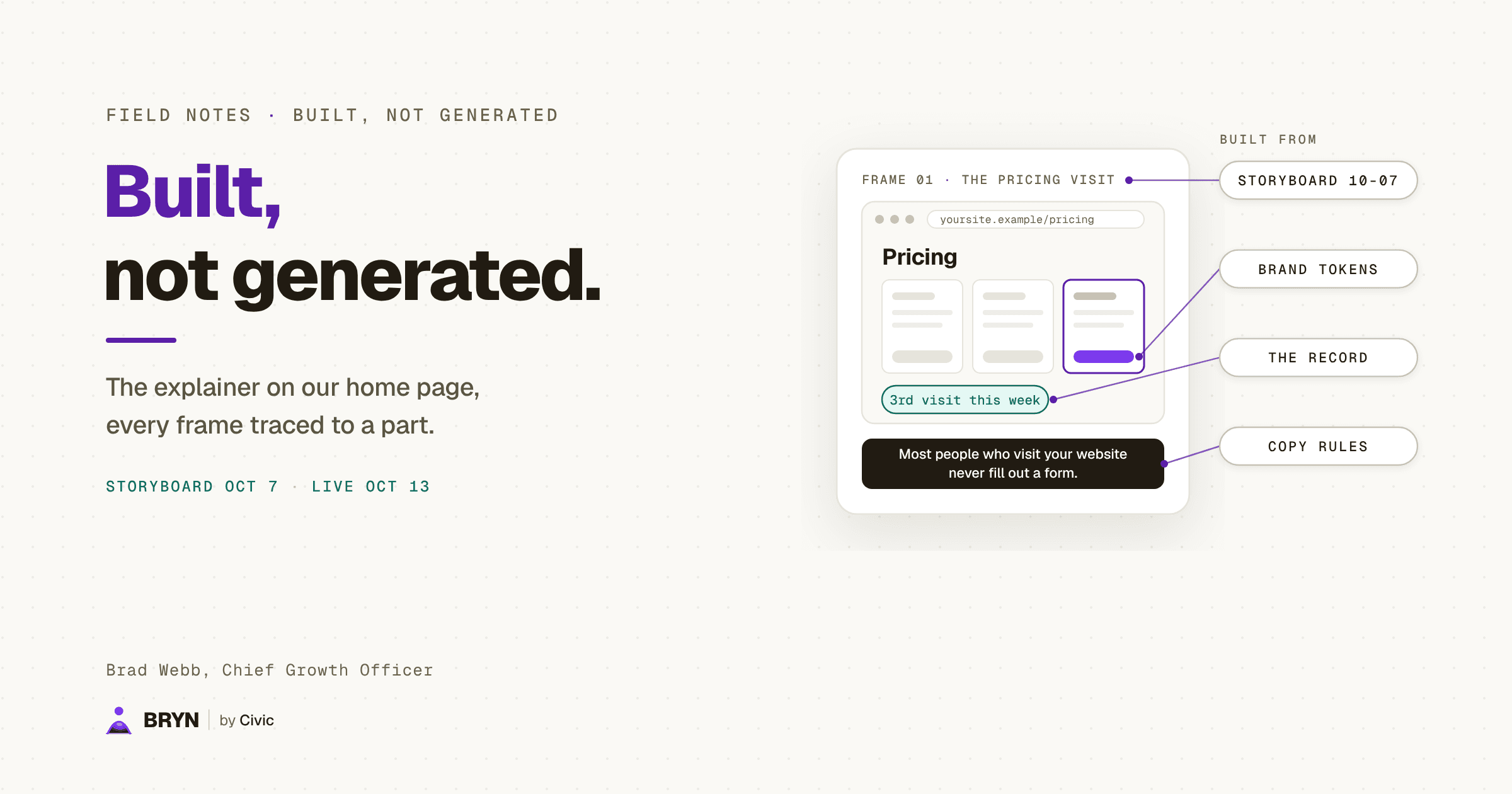
The video at the top of this page is the one on our home page. It's called How Bryn Works and it runs 1:16. The storyboard was filed on October 7. The cut was live by October 13. Storyboard to live, inside a week.
I'd expect most people to assume the fast part was a prompt: somebody described the video to a model, picked the least strange result, and went to lunch. That isn't what made it fast. What made it fast is that every number in it traces to a place you can open. Each number on screen is one the demo workspace, a sample account inside the product, actually holds. The voice is synthetic. The words it reads aren't: every line of the voiceover started as a row in the storyboard. The colors came from a brand system that was already written down. The week went on assembly, because the parts were already there.
The video follows one signal: something a buyer just did, like coming back to your pricing page. A company opens pricing for the third time this week. Bryn, the agent we built at Civic to spot buyers on your site and run the follow-up you approved, works out who it is. Then a rule fires, the team hears about it in Slack, and the run leaves a receipt. This piece is about how it got made, and about the bigger version of the same idea.
Where the number came from
There are two ways to make a marketing asset now, and from across the room they look the same.
Generated means a prompt goes in and an asset comes out. It can be beautiful. What it doesn't have is a source behind any frame. The chart in the corner is chart-shaped. The quote is quote-shaped. The number on the dashboard is whichever number looked right.
Built means parts go in and an assembly comes out. The parts already exist and already have owners: the product's own screens, the values in a demo workspace, the brand's colors and type, the copy rules, a storyboard somebody signed off. Assembly is the work. Every frame in the result can point at the part it came from.
The tell is one question. Ask where a number came from. In a generated asset the answer is "the model," which is another way of saying nowhere. In a built one, the answer is a place you can open. The "3rd visit this week" in the first frame of our video came from the demo workspace. The storyboard's rule was that the words "Demo workspace" appear on screen once, so every number in the cut is visibly the workspace's own, and nobody watching has to take it on faith.
Fortune wrote last Thursday about Apple stitching its old rainbow logo by hand and releasing a video of the hands at work, and the line I kept was that the people behind the work can become part of the pitch. I'd put it one notch more plainly. Care shows when every part has a source.
Here's the cut taken apart, beat by beat.
What each frame was built from.
The How Bryn Works cut, beat by beat. Pick a beat: the table shows each part of that frame, where the part lives, and the rule it was checked against.
| Beat | Part | Where it lives | Checked against |
|---|---|---|---|
| 01 The pricing visitOn screen: a website's pricing page opens; small text, 3rd visit this week. | "3rd visit this week" | the demo workspace's visit log | every number on screen is the workspace's own |
| The website | the storyboard's first row: a realistic site | no stock footage | |
| The voiceover line | the storyboard, filed Oct 7 | the cold-surface copy rules | |
| 02 The company resolvesOn screen: the visit flows in; the company behind it resolves, then a role, when one is available. | The company name | the demo workspace | every name and number on screen is the workspace's own |
| "When available" | the storyboard's second row | the product's own promise: a person only when possible | |
| The voiceover line | the storyboard | the cold-surface copy rules | |
| 03 Context, third visitOn screen: pricing, third visit, this week; no big score yet. | The context line | the demo workspace's activity for that company | every number on screen is the workspace's own |
| Holding the score back | the storyboard's scope | one loop, no scoring explained | |
| The voiceover line | the storyboard | the cold-surface copy rules | |
| 04 The approved ruleOn screen: the rule appears (a good-fit company returns to pricing, so tell Slack and create a CRM task), with "Approved by you" highlighted. | The rule | the demo workspace's own rules | shown as written, in one line |
| "Approved by you" | the storyboard's fourth row | a rule runs only after a person approves it | |
| The voiceover line | the storyboard | the copy rules: the product's name for a rule is never spoken | |
| 05 The alert and the taskOn screen: a Slack alert and a CRM task land; the timer reaches 37 seconds. | "37 seconds" | the demo workspace's own run | the "Demo workspace" stamp, on screen once |
| The alert and the task | the demo workspace's connected tools | every motion is a change of state | |
| The voiceover line | the storyboard | the cold-surface copy rules | |
| 06 The receiptOn screen: the receipt replaces the screen, in plain rows: Saw, Decided, Acted, Recorded. | The four rows | the shape of the product's own run record | what it saw, why it acted, what it did, where it landed |
| The row labels | the storyboard's seventh row | plain words, no undefined product nouns | |
| The voiceover line | the storyboard | the cold-surface copy rules | |
| 07 The Brief offerOn screen: the website field and the button, Get my Site Brief; text, No install required for your Brief. | The button text | the home page's own button | the live page, word for word |
| The lockup and colors | the brand system | the lockup at the end, never animated at the start | |
| The voiceover line | the storyboard | the cold-surface copy rules |
Keyboard: Tab to the beats, then the arrow keys, Home and End. The table follows the beat in focus.
On screen A website's pricing page opens. Small text: 3rd visit this week.
| Part | Where it lives | Checked against |
|---|---|---|
| "3rd visit this week" | the demo workspace's visit log | every number on screen is the workspace's own |
| The website | the storyboard's first row: a realistic site | no stock footage |
| The voiceover line | the storyboard, filed Oct 7 | the cold-surface copy rules |
On screen The visit flows in. The company behind it resolves, then a role, when one is available.
| Part | Where it lives | Checked against |
|---|---|---|
| The company name | the demo workspace | every name and number on screen is the workspace's own |
| "When available" | the storyboard's second row | the product's own promise: a person only when possible |
| The voiceover line | the storyboard | the cold-surface copy rules |
On screen Pricing, third visit, this week. No big score yet.
| Part | Where it lives | Checked against |
|---|---|---|
| The context line | the demo workspace's activity for that company | every number on screen is the workspace's own |
| Holding the score back | the storyboard's scope | one loop, no scoring explained |
| The voiceover line | the storyboard | the cold-surface copy rules |
On screen The rule appears: a good-fit company returns to pricing, so tell Slack and create a CRM task. "Approved by you" is highlighted.
| Part | Where it lives | Checked against |
|---|---|---|
| The rule | the demo workspace's own rules | shown as written, in one line |
| "Approved by you" | the storyboard's fourth row | a rule runs only after a person approves it |
| The voiceover line | the storyboard | the copy rules: the product's name for a rule is never spoken |
On screen A Slack alert and a CRM task land. The timer reaches 37 seconds.
| Part | Where it lives | Checked against |
|---|---|---|
| "37 seconds" | the demo workspace's own run | the "Demo workspace" stamp, on screen once |
| The alert and the task | the demo workspace's connected tools | every motion is a change of state |
| The voiceover line | the storyboard | the cold-surface copy rules |
On screen The receipt replaces the screen, in plain rows: Saw, Decided, Acted, Recorded.
| Part | Where it lives | Checked against |
|---|---|---|
| The four rows | the shape of the product's own run record | what it saw, why it acted, what it did, where it landed |
| The row labels | the storyboard's seventh row | plain words, no undefined product nouns |
| The voiceover line | the storyboard | the cold-surface copy rules |
On screen The website field and the button, Get my Site Brief. Text: No install required for your Brief.
| Part | Where it lives | Checked against |
|---|---|---|
| The button text | the home page's own button | the live page, word for word |
| The lockup and colors | the brand system | the lockup at the end, never animated at the start |
| The voiceover line | the storyboard | the cold-surface copy rules |
Parts and rules as written in the storyboard of record, filed Oct 7. The numbers on screen (3rd visit this week, 37 seconds) are the demo workspace's own.
Where the agents earn it
None of this is new. Good teams have always built from parts. What's changed is what the parts cost to fetch. Pulling the real screen, finding the real value, checking a line against the rules, checking the caption again for the punctuation you banned: each one is a small errand, and a video is a long list of small errands. That's why generating was tempting. It skips the errands.
Agents don't make building fast by writing faster. They make it fast by running the errands. Fetch the part. Check it against the rule. Assemble. Check the assembly against the rule again, because the second pass is where the small mistakes turn up. The rules stay human. Somebody decided that every motion on screen would be a change of state, that the voice would read a script written line by line, and that the video would carry no metric the workspace doesn't hold. Those rules are the craft. Agents just stop them being the bottleneck.
I've made the other kind. A couple of years ago I made a slide background from a prompt. It took about a minute and it looked good. It had a little chart in the corner, rising, because the prompt said growth. In the meeting someone asked what the chart showed. It showed nothing. It was chart-shaped. I'd saved a minute and spent the next ten explaining a line that didn't measure anything. That's the trade generating offers: the time comes back later, in front of the person you least want to explain it to.
So the week was simple to describe. The storyboard came first, with its rules and its checks written down before production. The parts came from places that already existed. Then the checks, then the home page.

The two dates on the ends are on the record. What's between them is what the week was for.