
An opinion with a number on it
On Tuesday, Brad Webb, Civic's CGO, opened Briefs, by Bryn, as a Public Preview. Bryn, by Civic, is the agent that builds them. Name a company and Bryn reads its site, scores it against the kind of company Bryn is built to find (in this preview the customer is Bryn; the same read, scored against your customer, is being built into Bryn), finds the tools it runs and the people who would sign off, writes the first follow-up it would run, and sends the Brief, inside a minute. The site puts it in one line: "Bryn scores the buyers on your site and runs the follow-up; a Brief is that read on one account."
Most research tools stop at the score. A number arrives, a color goes with it, and how the number was made is left to trust. That is an opinion with a number on it. A Brief ends differently. Its last section, Section 07, is headed "This page is a Play that already ran", and it is the reason the score can be checked rather than believed.
Section 07, the Play that already ran
A Play is a rule you set once: when this happens, do that. Bryn calls that a Play. Every Brief was built by one of Bryn's own rules, and it ends on the receipt: the clock of each step, from the request to the action. Section 07 lays the rule out in four lines. The request was watched. The company was scored. The page and the email were the action. The record was written. Those are the same four steps Bryn runs on a customer's own traffic, here pointed at a request from a stranger.
The request is where it starts, and the request itself is a signal: something a buyer just did, like coming back to your pricing page. Bryn files it where the interest belongs. When someone at company A asks for a Brief on company B, the interest is A's. Bryn notes it against A, and A's team gets the Slack ping when the Brief is done. B's own page in Bryn stays B's, and Bryn reads nothing from it until it has checked, by B's domain, that the page is B's.
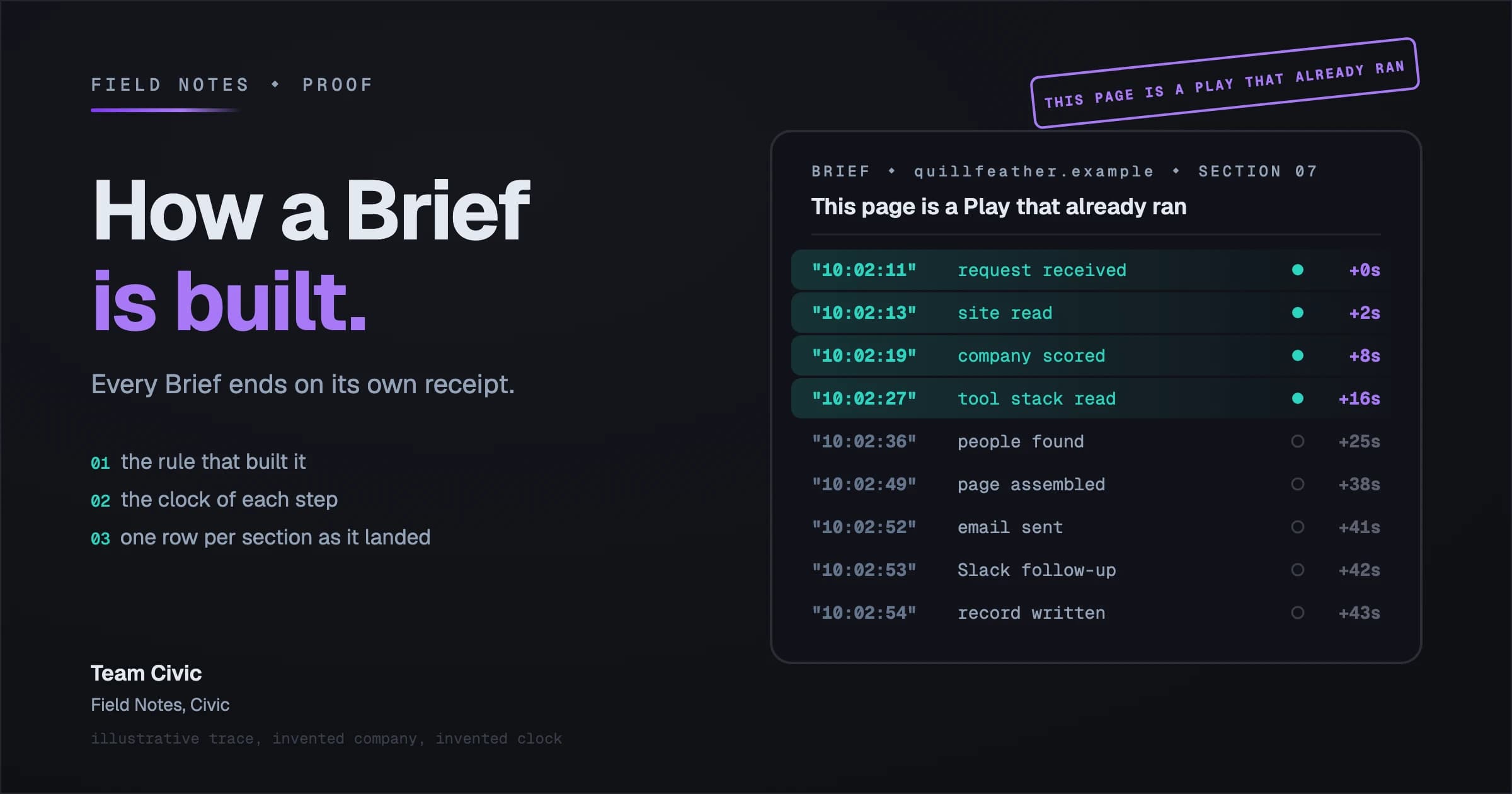
Under the rule runs the Play trace: one row per step, each with the clock, from the request to Bryn's own follow-up in Slack, and the time elapsed. Under the trace sits the receipt, one row per section as it landed. Here is one trace for two invented companies. Someone at larkspur.example asked about quillfeather.example. Every stamp and value is illustrative.
"10:02:11"Request received, and filed on the asker's record."10:02:13"Site read: the home page, the pricing page, the docs. A site reader."10:02:19"Company scored, against that profile. The scorer. The score lands first."10:02:27"Tool stack read: the page, the tag manager, the company's own domain and mail records. A tag reader."10:02:36"People found: who would sign off, with a title read from a source. A people finder."10:02:49"Page assembled, section by section, in the company's own colors. The assembler."10:02:52"Email sent to the person who asked. The sender. The email is the Brief, not a notification."10:02:53"Slack follow-up posted: Bryn's own, once the work is done."10:02:54"Record written. Section 07 closes, forty-three seconds after the request.
Step through the same rows below. Each row shows its clock stamp, the step in plain words, the kind of tool, the time elapsed, and the section of the Brief it landed.
Section 07, row by row.
Step through one illustrative Play trace. Left: the trace row and what it means in plain words. Right: the Brief, with the section that row landed highlighted. Use the row buttons or Prev and Next; Left and Right arrows, Home and End work while a row button has focus.
(illustrative run: someone at larkspur.example asked about quillfeather.example; every clock stamp is invented)
The request was watched. The company was scored. The page and the email were the action. The record was written. Under the rule, the trace. Under the trace, the receipt.
Row 1 of 9 ⬩ +0s ⬩ lands: the Brief's header, asked for
"10:02:11", +0s. Someone at larkspur.example asked for a Brief on quillfeather.example. The request is a signal, something a buyer just did, and Bryn notes it against larkspur, and larkspur's team gets the Slack ping when the Brief is done. Quillfeather's own page in Bryn stays quillfeather's, and Bryn reads nothing from it until it has checked, by domain, that the page is quillfeather's. Lands: the Brief's header, asked for.
- Asked forby someone at larkspur.example, filed on larkspur's record (illustrative)landed "10:02:11"
- Brand and key pageshome, pricing, docs; the company's own colors
- The score ⬩ does it look like a buyerwhat Bryn looked at, what would move it
- Tool stackwhat is already running, and where each was proved
- People who would sign offRKAOJM initials only (illustrative)
- The first follow-up Bryn would runwho to reach, about what, and what runs after
- Emailthe Brief itself, to the person who asked
- SlackBryn's own follow-up, once the work is done
- 07 ⬩ This page is a Play that already ran
"10:02:11" request received      +0s
"10:02:13" site read             +2s
"10:02:19" company scored        +8s
"10:02:27" tool stack read      +16s
"10:02:36" people found         +25s
"10:02:49" page assembled       +38s
"10:02:52" email sent           +41s
"10:02:53" Slack follow-up      +42s
"10:02:54" record written       +43s
(illustrative) Clock stamps and initials are invented. Tool classes, not products. The whole run finishes inside a minute.
"10:02:11" request received ⬩ signal ⬩ +0s ⬩ filed on: the asker's record, larkspur.example
Someone at larkspur.example asked for a Brief on quillfeather.example. The request is a signal, something a buyer just did, and Bryn notes it against larkspur, and larkspur's team gets the Slack ping when the Brief is done. Quillfeather's own page in Bryn stays quillfeather's, and Bryn reads nothing from it until it has checked, by domain, that the page is quillfeather's.
Lands: the Brief's header, asked for.
"10:02:13" site read ⬩ site reader ⬩ +2s ⬩ source: quillfeather.example: home, pricing, docs
Bryn reads the company's own pages first: the home page, the pricing page, the docs. The brand comes from here too, the logo, the palette, the type, so the Brief arrives in the company's own colors. This is where the brand and key pages section comes from.
Lands: brand and key pages.
"10:02:19" company scored ⬩ scorer ⬩ +8s ⬩ source: the site read, against that profile
The score lands first. Bryn scores the company against that profile, with the same weights and the same bar a customer's own account would have to clear, and prints what it looked at and what would move the number. Does it look like a buyer.
Lands: the score.
"10:02:27" tool stack read ⬩ tag reader ⬩ +16s ⬩ source: the page, the tag manager, the company's own domain and mail records
The page, the tag manager, and the company's own domain and mail records say which tools are already running. Each tool found becomes a tile, with a word for where it was proved. A tool with no proof behind it is not a tile.
Lands: tool stack.
"10:02:36" people found ⬩ people finder ⬩ +25s ⬩ source: public profiles and titles
The people who would sign off, each with a title read from a source. Initials only in this illustration. Nobody is added to make the list look fuller.
Lands: people who would sign off.
"10:02:49" page assembled ⬩ assembler ⬩ +38s ⬩ source: every row above, section by section
The assembler puts the sections in order, in the company's own colors, and writes the first follow-up Bryn would run from everything above. A section that comes back with a gap is repaired on its own, and the sections already landed stay put.
Lands: the first follow-up Bryn would run.
"10:02:52" email sent ⬩ sender ⬩ +41s ⬩ to: the person who asked
The email goes to the person who asked. It is the Brief, not a notification: the score, the tools that connect, one insight, and the first follow-up, in the company's colors.
Lands: email.
"10:02:53" Slack follow-up posted ⬩ sender ⬩ +42s ⬩ Bryn's own follow-up
Bryn's own follow-up lands in Slack, once the work is done. You don't have to check Bryn. Bryn checks in with you, once the work is done.
Lands: Slack.
"10:02:54" record written ⬩ Section 07 ⬩ +43s ⬩ the rule, this trace, the receipt
The record is written and Section 07 closes: the rule that built the page, this trace with the clock on every row, and the receipt, one row per section as it landed. Forty-three seconds from the request, inside a minute (illustrative).
Lands: 07, this page is a Play that already ran.
Forty-three seconds, in this illustration. The run has a sixty-second wall, and the page finishes inside it or says which section is still coming while the rest keeps moving. A section that comes back with a gap is repaired on its own, and the sections already landed stay put. Ask about the same company again inside thirty days and you get the same Brief back, not a second run. Open it later and the score has re-read itself, with a line headed "Since this Brief was sent" beneath it; that part is Tuesday's story, in Brad's Let me be Brief...