Noise-to-Motion/#016/Post
SaaStr's inbound agent checks its own records first. Copy the order
Enrichment tells you who a company is, but your own records tell you what it's already done with you, and only that changes the first reply to an inbound lead.
01 ⬩ What shipped
SaaStr's agent checks its own records before it enriches
Jason Lemkin, founder of SaaStr, published SaaStr's agent-led growth playbook on Oct 24, and the inbound section is the part to copy this week. When a lead comes in, SaaStr's agent checks what SaaStr already knows about the company before it asks any enrichment tool. My read: the first reply to an inbound lead is won on context you already own, and most teams look it up last, if they look at all.
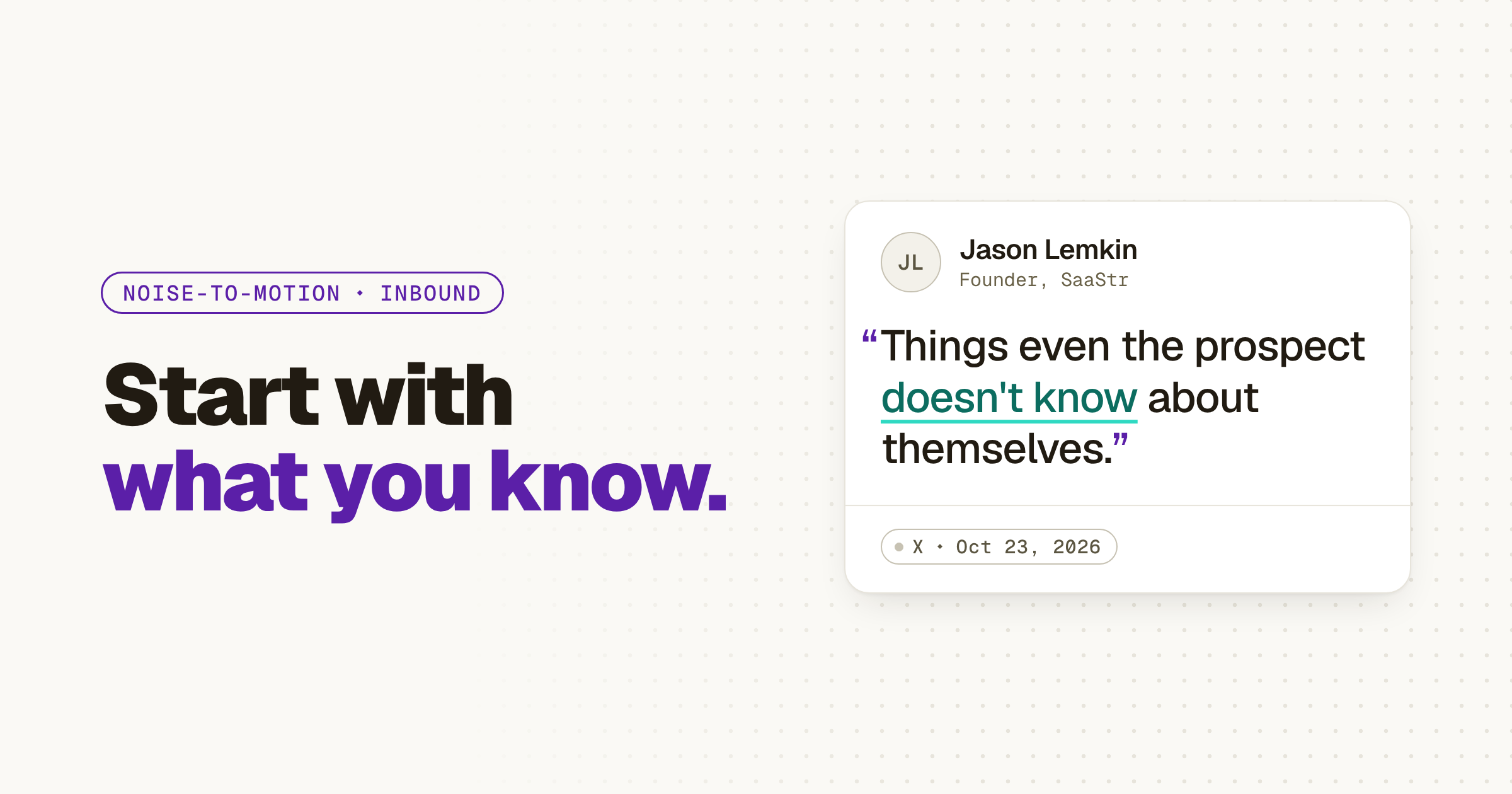
Lemkin's write-up on SaaStr lays out four chained steps for every inbound: SaaStr's own data, then enrichment from Exa, Sumble and CoreSignal, then a prospectus page written for that company, then an email with a meeting booker SaaStr built itself. Step one asks four questions. Have they attended an event? Are they on the newsletter? Is there an open opportunity? Did they download the sponsorship prospectus? Here's how he summed it up on X.
02 ⬩ What it changes
The record knew what the lead didn't
SaaStr's example is a real lead from Base44. The first check found that Base44's CEO and leadership team had already attended SaaStr. The person who filled in the form didn't know that. Exa added that Base44 is owned by Wix, which Amelia, who built SaaStr's inbound queue, had forgotten, so she asked on the first call how Wix factors into the decision. The lead booked a meeting within 10 minutes.
Here's the part I'd underline. Enrichment tells you who the company is. Your own records tell you what they've already done with you, and only the second one changes the first reply. Lemkin says the same about outbound. He rated SaaStr's AI emails about a 5 out of 10, against a 2 or 3 for most human outbound, and says they stalled there because they had almost no first-party data.
03 ⬩ What it takes
You don't need 30 tools for step one
SaaStr's main agent, 10K, now connects to more than 30 core tools. It started 16 months ago as a helper for Notion, and SaaStr added tools the way you'd widen a new hire's access as they prove out. In Amelia's first week, the inbound queue handled inbound and nothing else. For a team with almost nothing connected, Lemkin's advice is to give the agent whatever Salesforce data or spreadsheets you have.
A team of one can run step one before it runs an agent. The facts already sit in tools you pay for: the event list, the newsletter, the CRM, the download log. They just aren't open when the reply gets written. A Field Note here argued that outreach should start from the account that's already looking. Inbound is the easy case. The account has already raised its hand. The full session is on SaaStr AI's YouTube channel.

04 ⬩ The move
Check what your last ten replies knew
You can test this on last month's inbound before you buy anything. Pull the leads, pull the first reply each one got, and line them up against what your own tools knew on the day the form came in.
If the replies read the same with or without that history, that's the gap, and it's cheaper to close than another enrichment seat.
- 1Pull your last ten inbound leads and the first reply each one got.
- 2List what your own tools knew: past events, the newsletter, open deals, downloads.
- 3Mark each fact that made it into the reply.
- 4Put the missing ones where whoever answers inbound reads them before replying.
05 ⬩ Sources
Where this came from
- The Agent-Led Growth Playbook: A 10-Minute Inbound Booking, a 46-of-50 AEO Score, and Why First-Party Data Beats Every Signal Tool | The Agents #017, SaaStr,
- Jason Lemkin (@jasonlk) on X,
- Jason Lemkin (@jasonlk) on X,
- The AEO Playbook: How to Get Picked by Agents | The Agents #17, SaaStr AI on YouTube,
Get the next one the day it lands.Follow on LinkedIn