Noise-to-Motion/#015/Post
Google is dropping words from tracked queries. Recheck the long tail
Google has been answering one word of the queries rank trackers send, on up to two fifths of results pages a day at its September peak, and the long, quiet queries a small B2B team tracks are where it hits hardest.
01 ⬩ What shipped
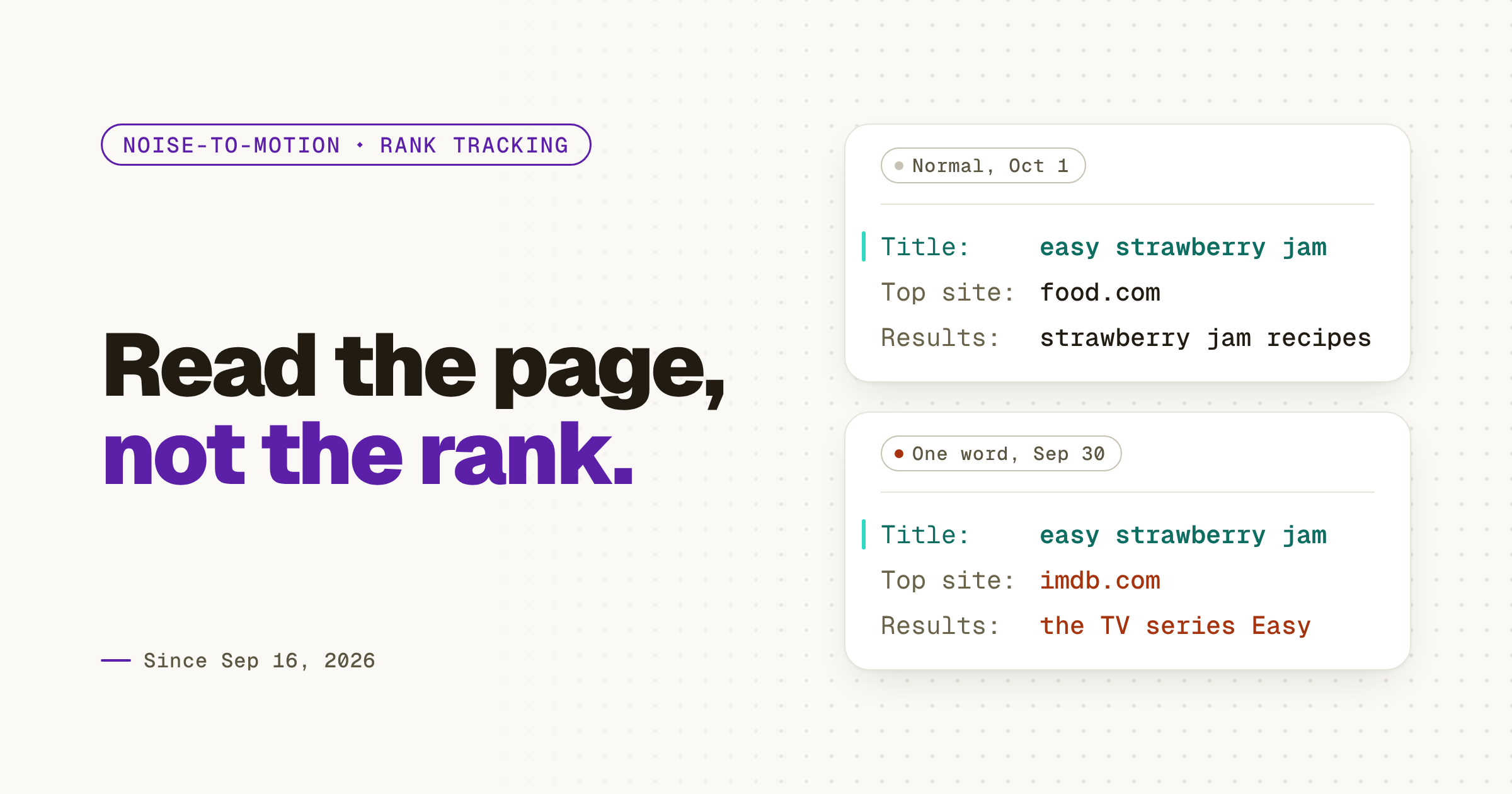
Google is answering one word of the query you track
Nozzle published a study on Oct 22, 2026 showing that Google has been serving rank trackers results pages that keep the full query in the title but answer only one word of it. My read: the long, quiet queries a small B2B software team tracks are where it bites, so a one-day drop on one of those since mid-September is suspect until you've looked at the page.
Nozzle's study, "Google Plays Dumb", judged 248 million results pages. From September 16, page 1 or page 2 ignored part of the query on 13.9% of the desktop pages judged on both, against 0.06% before, and on 39.9% at the peak on September 28. Page 2 went first. Page 1 alone has run 0.7 to 3.8% a day since September 20, against 0.02% before. Nozzle's cleanest example is "easy strawberry jam", answered with results about the TV series Easy. Derek Perkins, who wrote the study, put it plainly.
02 ⬩ What it changes
Your long tail is where the tracker is least right
The total isn't the number to watch. The split is. Nozzle broke page 1 down by query, and longer queries get hit more: 0.9% of two-word queries against 3.2% of five words or more. Quieter ones too: 2.1% of queries under 100 searches a month, against 0.5% at 100,000 or more. US software and technology queries ran 1.9% since September 16.
A small B2B software company rarely tracks the head term. It tracks the long, specific query a handful of buyers type when they're close to choosing. So the tracker is least reliable on the queries you care about most, and those are the ones nobody double-checks because the volume looks too small to matter. When your own site is one of a keyword's usual results, Nozzle found it out of the top 10 on 69.8% of these pages, against 2.0% before. The next check within three days answered the query again 85.8% of the time. A weekly report is where a one-day crash turns into a trend.
03 ⬩ What changed this week
Google stepped up twice more since last week
Last week I wrote that a one-day drop is a question until Search Console agrees. Google hasn't let up. AccuRanker updated its study on the AccuRanker blog after Google tightened its detection twice more, late on October 20 and late on October 23. On October 24, Google poisoned 40% of AccuRanker's first desktop fetches. After its checks, 3.2% of the desktop keywords it stored still had a swapped page 1, and it says the October 23 step hasn't fully gone away. Its advice is to check any sudden drop on October 16, 21 or 24. Google has made no statement. Glenn Gabe, the search consultant who's been comparing tools since September, read the update the same way on Oct 26.
The tool makers now say it in their own words. Ahrefs, in its Oct 22 update: "Depending on the data provider, we're seeing between 5% and 20% of search results affected in this way." Semrush, in a statement Barry Schwartz added to his running Search Engine Roundtable story on Oct 27: "There can still be individual cases, most often beyond the first page of results." Beyond page one is where the long tail lives.
04 ⬩ What to do
Read the page, not the rank
A position can't tell you which fault you're looking at. The stored page can. Nozzle's tell is plain: the title still shows your full query on 99.8% of these pages, with no "Showing results for" line, while the results are about one of its words. On desktop keywords that usually run to page 8, the page numbers stopped by page 4 on 43.0% of them, against 0.2% normally. Start with your longest, quietest keywords, because that's where the odds are worst, and keep last week's Search Console check for the rest. The outside reading is a rental; what your own site recorded is the record. The Context Layer Is Not the Decision makes the same split for company data.
- 1Sort by length. Put tracked keywords of five words or more, and the lowest-volume ones, at the top.
- 2Pull the one-day drops since September 16, plus every drop on October 16, 21 or 24.
- 3Open the stored page. Full query in the title, results about one word: that day doesn't count.
- 4Confirm in Search Console by query and date. Act only if position and clicks fell too.
05 ⬩ Sources
Where this came from
- Google Plays Dumb, Derek Perkins, Nozzle,
- How AccuRanker Handles Poisoned SERPs, Peter Emil Tybirk, AccuRanker, , updated with data through Oct 25
- An update on Google's poisoning of search results, Ahrefs,
- Third-Party Google Rank Tracking Struggling Now, Barry Schwartz, Search Engine Roundtable, , updated Oct 27 with Semrush's statement
- Derek Perkins (@Derek_Perkins) on X,
- Glenn Gabe (@glenngabe) on X,
- Barry Schwartz (@rustybrick) on X,
Get the next one the day it lands.Follow on LinkedIn