Noise-to-Motion/#018/Post
SaaStr's agents now pick its vendors. Ask one what it would buy
An agent with your buyer's whole stack in view now writes the shortlist, and it can rule you out on one line before a person ever hears your name.
01 ⬩ What shipped
SaaStr's agents now pick its software
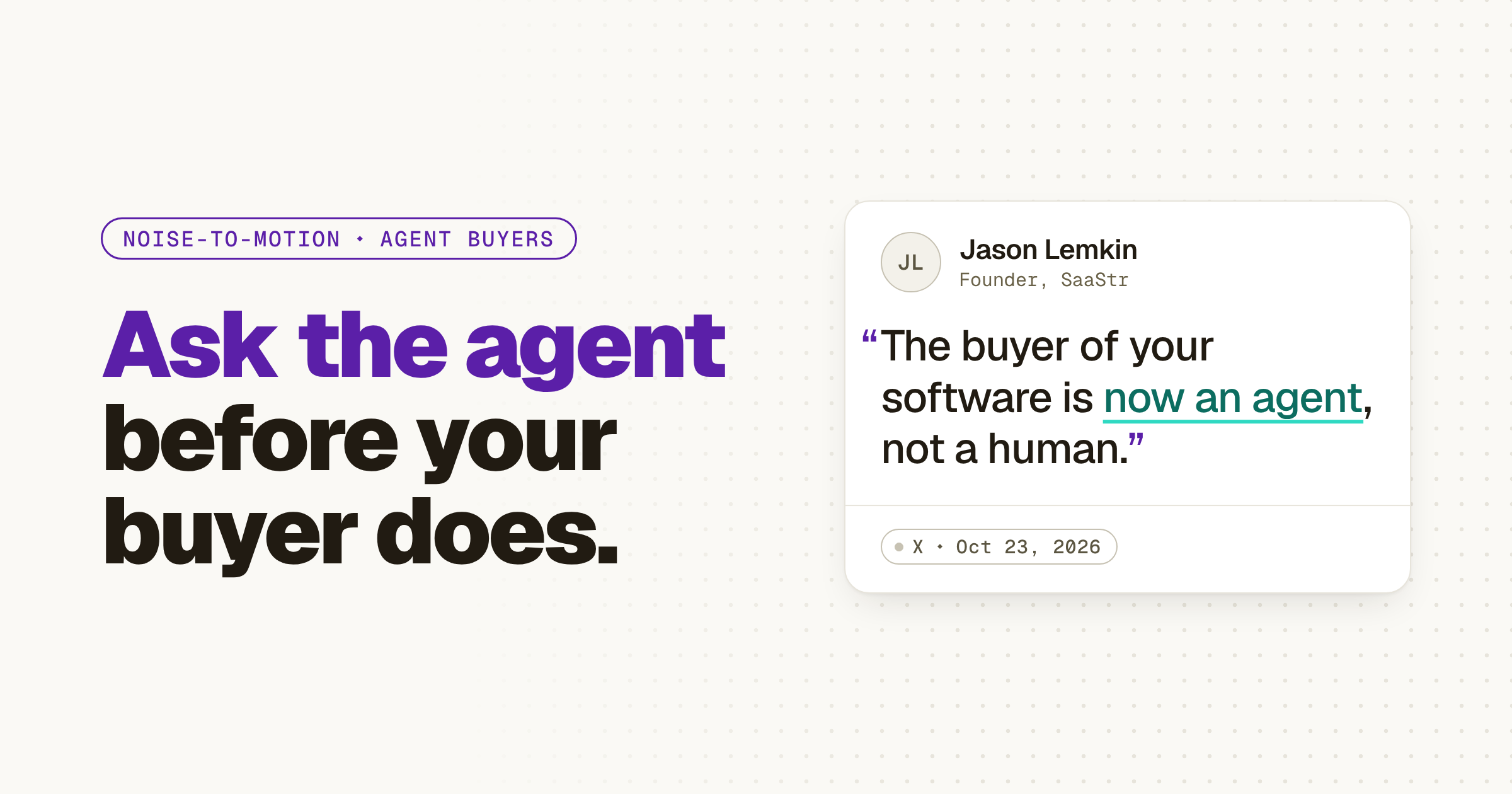
Jason Lemkin, founder of SaaStr, wrote on Oct 23 that SaaStr's agents now start many of its vendor decisions and finish some of them. My read: your next buyer's shortlist is being written by something with their whole stack in view, and you won't know you were on it.
In his post on SaaStr, Lemkin says the company runs 21+ agents in production with three humans. He asked the agent behind SaaStr Connect, its recruiting app, what it would run on at scale. It named Render its pick, put Railway second and Vercel fifth, and ruled Vercel out for minutes-long jobs and background workers. Lemkin isn't sure that last call was right. Render won anyway, without a sales call, an ad or a search ranking. Here's how he put it on X.
02 ⬩ What it changes
It's a different buyer from a person asking ChatGPT
Most of the work on getting found by AI assumes a person typing a question into OpenAI's ChatGPT or Anthropic's Claude, with one chat's worth of context. Lemkin draws a line between that and an agent working inside the company, which sees the company's data, integrations, volumes and costs before it recommends anything. It also says things no sales rep would. His told SaaStr to stay on Salesforce and not migrate.
Here's the part I'd underline. A deal you lose to an agent leaves nothing in your CRM: no meeting, no lost reason, no last email that went unanswered. The only way to see that decision is to run it yourself. A Field Note here made the case that your buyer's AI does the research before a person shows up to verify it. This is the step after, where the agent makes the call and the person often takes it.
03 ⬩ What it costs
Agents do the pricing math, then move on
The churn runs faster than the pick. Lemkin writes on SaaStr that 10K, the agent he calls SaaStr's AI VP Revenue, shortlisted a vendor on its own and then ran the pricing: premium rates, minimums of several months, and no conversion data to justify either. In under 12 hours it had moved to the next name on its list. Nobody escalated, nobody offered a discount, and the vendor may never learn why.
The same goes for how you charge. Lemkin says the agent fought a product that billed for human seats, then agent seats, then API calls on top. On SaaStr's YouTube channel he goes further: "I doubt an agent would recommend picking any system of record that materially charges for API access."

04 ⬩ The move
Ask an agent what it would buy
Lemkin's advice to SaaStr's portfolio companies is to find people with agents in production in their category and have them ask, every two weeks, what to use for the job the company does. A team of one can run a smaller version this week. Take one real customer's stack and the job they bought you for, hand both to an agent, and ask what it would use.
Then read the reasoning for the line that decides it. Vercel lost on one. "Every vendor has a sentence like that in some agent's reasoning." If yours is a doc that's out of date or a price page that takes a call to understand, that's the fix, and it costs less than a deal you never knew you lost.
- 1Pick one real customer and write down their stack and the job they bought you for.
- 2Ask an agent what it would use for that job, with that stack as its context.
- 3Save its reasoning and mark the line where it rules you in or out.
- 4Fix what that line points at: the doc, the price page or the API reference.
- 5Ask again in two weeks, since the answer moves as the agents do.
05 ⬩ Sources
Where this came from
Get the next one the day it lands.Follow on LinkedIn