Noise-to-Motion/#013/Post
Google says noindex pages users share by link. Set your default
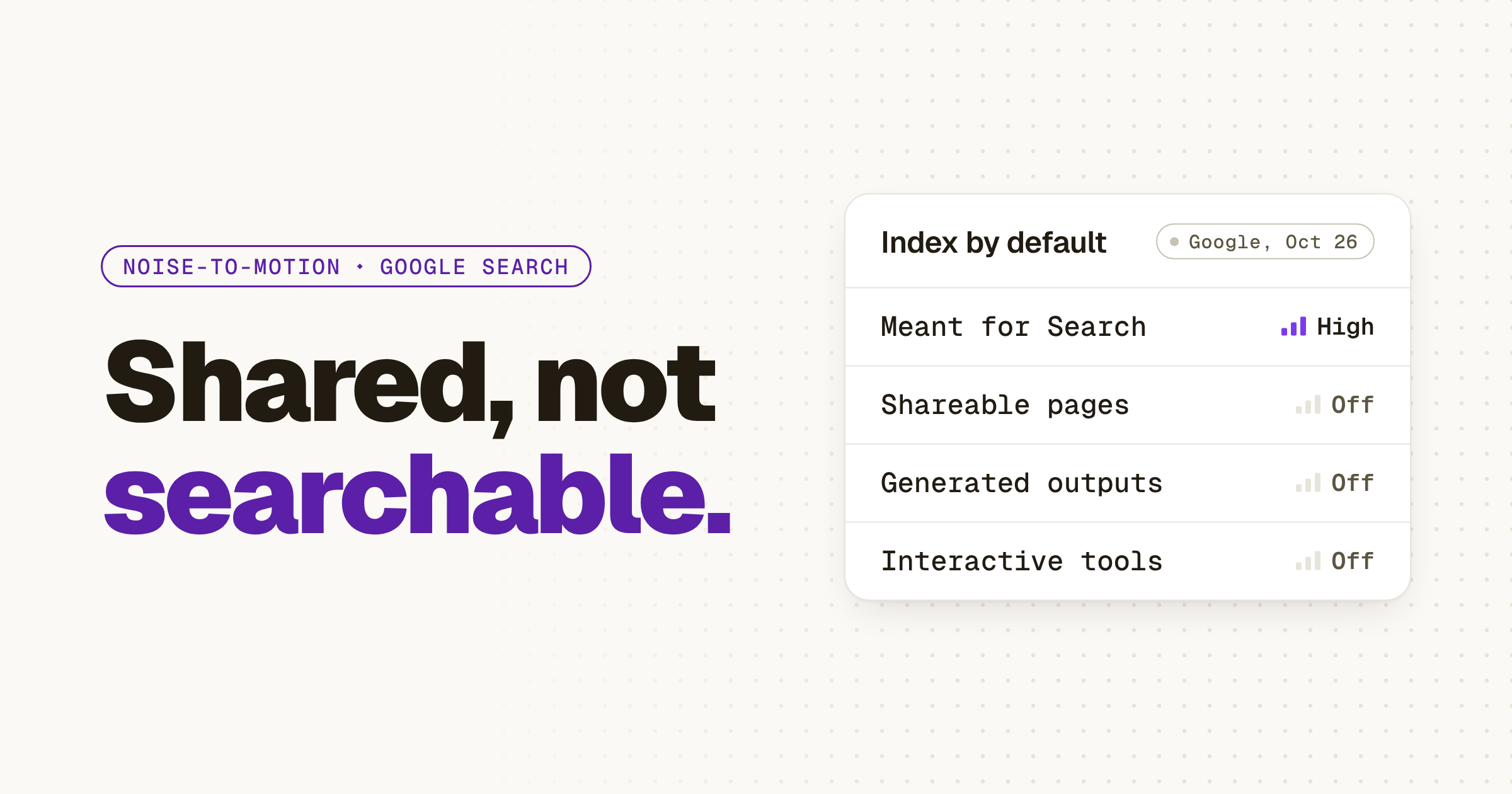
Google's spam guide now tells any product that lets users publish shareable pages, generated outputs or interactive tools to noindex the link-only ones by default, so the share link your product grows on needs a decision this week.
01 ⬩ What shipped
Google named share links in its spam guide
Google updated its guide to preventing user-generated spam on Oct 26, 2026, and it now names products that let users publish shareable pages, generated outputs or interactive tools. My read: if your product gives a customer a link to something it made, whether that page sits in Google's index is now a choice you make on purpose, and Google's answer for link-only pages is noindex.
The new section in Google Search Central's guide to preventing user-generated spam is called "Only index content meant for Search." It asks whether a page is meant to be found through a search engine or only opened by people who have the link. For the second kind, Google is direct: "When pages are created for direct sharing, collaboration, or utility rather than public search discovery, apply the noindex rule." That means a robots meta tag or an X-Robots-Tag header, or a crawl block in robots.txt, by default. Google's documentation changelog says the change is about blocking the indexing of link-shared content and catching abuse earlier in Search Console.
02 ⬩ What it changes
The share link works both ways
Plenty of B2B software lets a customer share what it made: a report, a dashboard, a proposal, a page an agent wrote. The link travels, which is the point. A buyer's colleague opens it and lands on your domain without ever searching for you. Google's guide describes the other person using the same feature: someone who signs up, publishes pages in bulk and lets your domain carry them. The feature that brings a buyer's colleague to your domain is the same one a spammer uses to fill it, so the default you pick for one is the default you pick for both. If you can't say which way yours is set, nobody picked. It shipped with whatever the framework did. Glenn Gabe, the SEO and AI search consultant at G-Squared Interactive, read the update on Oct 26 and didn't hedge.
03 ⬩ Who it's aimed at
The people who watch Google read it as a warning
The guide doesn't announce a penalty. It does tell you to verify your site or subdomain in Search Console so you get the email if Google issues a manual action, and to watch the Page Indexing and Search performance reports for spikes that don't match what your product is for. Barry Schwartz, executive editor of Search Engine Roundtable, wrote up the change on Search Engine Roundtable with the before and after. Lily Ray, an SEO practitioner, went straight to the tools she thinks Google has in mind.
Read the other way, her list is a note for your own team. If the calculator or guide you want buyers to find lives on a share link in somebody else's tool because it was quick, it's sitting in the pile she's describing. Put the pages you want found on your own site.
04 ⬩ What to do
Decide which pages were meant to be found
The fix is a decision, then a default. List every kind of page a customer can publish from your product, plus the ones your team publishes on other people's tools. Mark each one: meant for Search, or link only. Link-only pages get noindex from the moment they're created. Google's guide keeps a softer option for pages that might earn a place: noindex what new users publish, and let it into the index once the user has a reputation on your service. Then watch for the pattern Google names: a spike in new public pages, or a few users creating a large share of your indexable URLs. The pages you do want found are the ones a buyer's AI reads before a person comes to check. Your Buyer's AI Does the Research is the case for spending the effort there.
- 1List what customers can publish. Reports, dashboards, generated pages, tools.
- 2Mark each kind. Meant for Search, or opened by people with the link.
- 3Noindex the link-only kinds by default. A robots meta tag or an X-Robots-Tag header.
- 4Check Page Indexing weekly. A spike in indexed pages you didn't plan is the tell.
05 ⬩ Sources
Where this came from
- Prevent user-generated spam on your site and platform, Google Search Central,
- Updated guidance on preventing user-generated spam, Google Search Central documentation updates,
- Google Warns Tools On User-Generated Spam Guidance & More, Barry Schwartz, Search Engine Roundtable,
- Glenn Gabe (@glenngabe) on X,
- Lily Ray (@lilyraynyc) on X,
Get the next one the day it lands.Follow on LinkedIn