
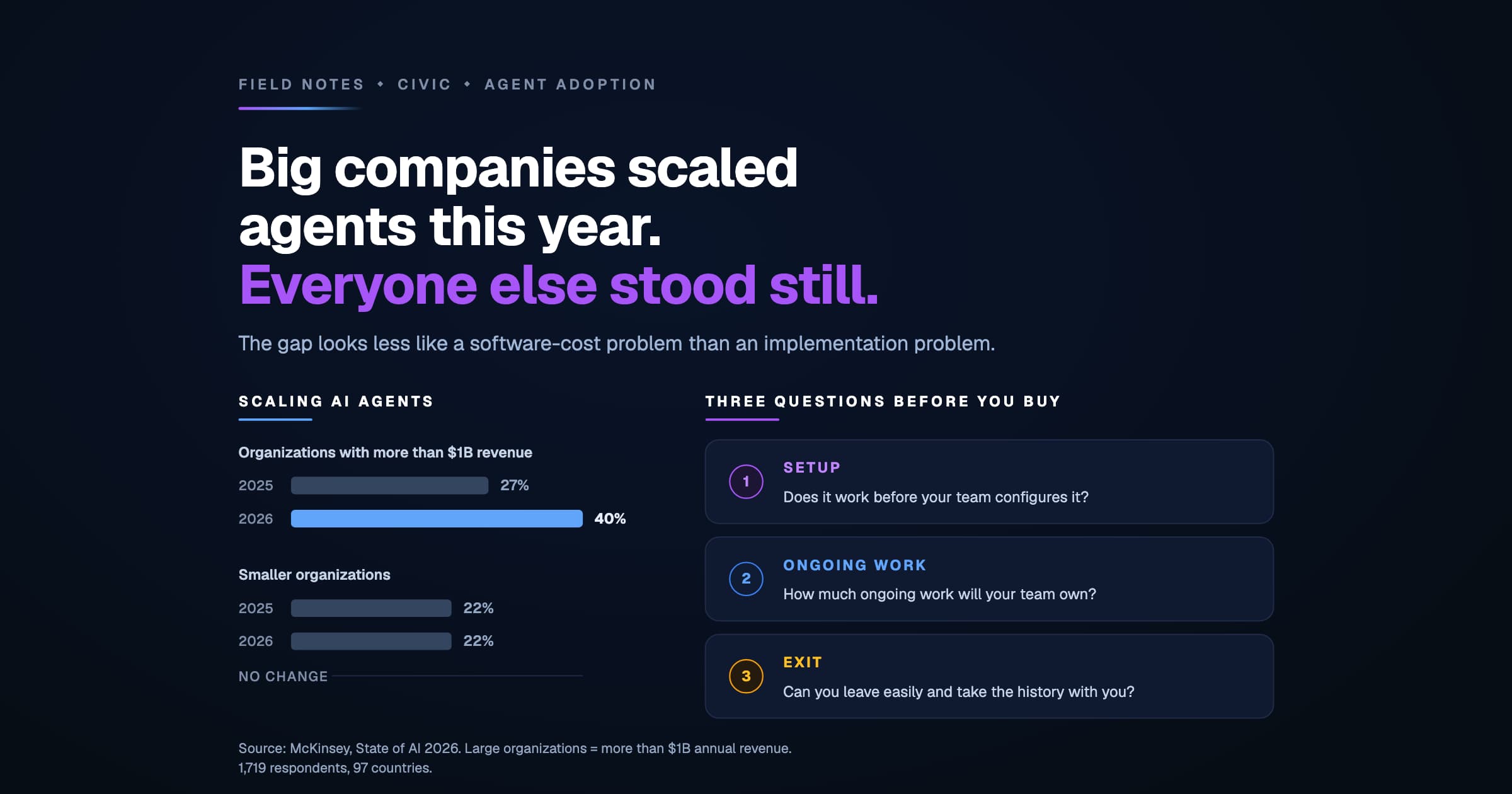
Among organizations with more than $1 billion in revenue, 40 percent are now scaling AI agents, up from 27 percent last year. Among smaller organizations, the figure is 22 percent, unchanged. Software cost alone does not explain that gap.
McKinsey published its 2026 State of AI survey on August 25, based on 1,719 respondents across 97 countries.
The number that matters most to me is the split by company size. Among organizations with more than $1 billion in annual revenue, 40 percent are scaling AI agents, up from 27 percent last year. Among smaller organizations, 22 percent are scaling agents, essentially unchanged.
The broader survey makes the contrast more useful. Forty-four percent of organizations now say AI is scaling across the enterprise, up from 38 percent last year. But the share reporting any EBIT impact is essentially unchanged at 37 percent, and only about 6 percent qualify as AI high performers.
Large enterprises pulled ahead on agents while smaller organizations stayed flat. If you run a smaller software company, that is the part of the survey worth paying attention to. The question is why.
Budget matters. It does not explain the gap by itself.
The easy explanation is that large enterprises can afford agents and smaller companies cannot. The survey itself points to a more complicated answer.
About one in five respondents say AI operating costs, including token costs, have constrained their AI use, and McKinsey reports those constraints across the full range of AI tools. For AI agents specifically, about one in ten respondents cite cost as a constraint. Yet agent scaling moved sharply at billion-dollar companies and barely moved at smaller ones.
What separates the companies getting the most value is less about access to the technology and more about how they operate. McKinsey's high performers are much more likely to redesign workflows around AI rather than insert AI into existing ones, twice as likely to say senior leaders demonstrate commitment to the work, and twice as likely to have defined processes to measure impact.
That is why I think the constraint for smaller companies is often implementation capacity. Many agent products assume the buyer has people available to configure the system, manage exceptions, work through security and data questions, and keep the workflow current.
A 5,000-person company is more likely to have those roles already. A 200-person company may have a head of growth with three direct reports and a quarter to make.
The product can be affordable and still be impractical to run.
These products will get easier to adopt over time. But the gap widened this year: large-company scaling rose from 27 percent to 40 percent while smaller-company scaling stayed at 22 percent. That matters because the advantage is not only the software. It is also the year spent learning how to use agents inside your own workflows.
Three questions to answer before you buy an agent.
The answers to these questions lead to a more useful evaluation question than "How capable is it?"
Most vendors can now produce an impressive demo. But the right question is whether your team can put the product into production and keep it useful without creating a new operating burden.
These three questions get you most of the way there.
Setup. What does it do before your team configures anything?
Ongoing work. What will your team have to do every week to keep it running?
Exit. If you stop using it, how easily can you leave and take the history with you?
Three questions to test whether an AI agent fits your team.
Answer based on what the vendor has actually shown you. You will see what the answers imply for setup, ongoing work, and exit, plus what to verify before signing.
| Question | Answer | What it means for your team | What to verify |
|---|---|---|---|
| Setup: does it do useful work before configuration? | Yes | Ready to use | Verify in the demo what the product does before configuration, on your data. |
| Setup: does it do useful work before configuration? | No | Requires configuration first | Verify who does the configuration, how long it takes, and what it costs. |
| Ongoing work: is the weekly work a light review? | Yes | Light review | Verify how many minutes of review a normal week actually takes. |
| Ongoing work: is the weekly work a light review? | No | Ongoing administration required | Verify which role on your team owns the weekly administration. |
| Exit: how long is the commitment? | Short | Leaving is inexpensive | Verify the renewal terms and any price step-ups. |
| Exit: how long is the commitment? | Long | Leaving costs money or time | Verify the early termination terms in writing. |
| Exit: can you export the history? | Yes | The operating record leaves with you | Verify the export format and whether it includes the full action history. |
| Exit: can you export the history? | No | The record stays behind | Verify whether any history can be retrieved at all after you leave. |
Complete all three sections to see what the product would require from your team and what to verify before signing.
Setup: make sure it works before you customize it.
A platform that can build anything is valuable if you have a team available to build on it. If you don't, flexibility can become work your team never budgeted for. Someone still has to decide what to build, configure it, and keep it current as the business changes.
Watch the demo closely. If most of it is spent showing you configuration tools, ask what useful work happens before your team touches them.
If the answer is none, you are buying a toolkit rather than a working process.
Ongoing work: count the hours your team will own.
Every agent vendor will tell you the agent does the work. Ask what work is left for your team.
Who reviews its actions? How long does that take? Who fixes it when a data source changes? Who handles security questions in month three? Who takes over if the internal champion leaves?
For a smaller team, the practical test is simple: does the agent remove recurring work, or create a new recurring process?
Ask the vendor to describe a normal Tuesday three months after launch.
Exit: make sure you can leave without losing the history.
Long commitments are not automatically bad, but they shift more risk to the buyer.
Ask two questions: what does it cost to leave, and what can I take with me?
The second matters because the history of what the agent did is part of how you judge whether it worked. If that history cannot be exported, switching products also means losing part of your operating record.
For a smaller team, short commitments and exportable history reduce the cost of being wrong.