
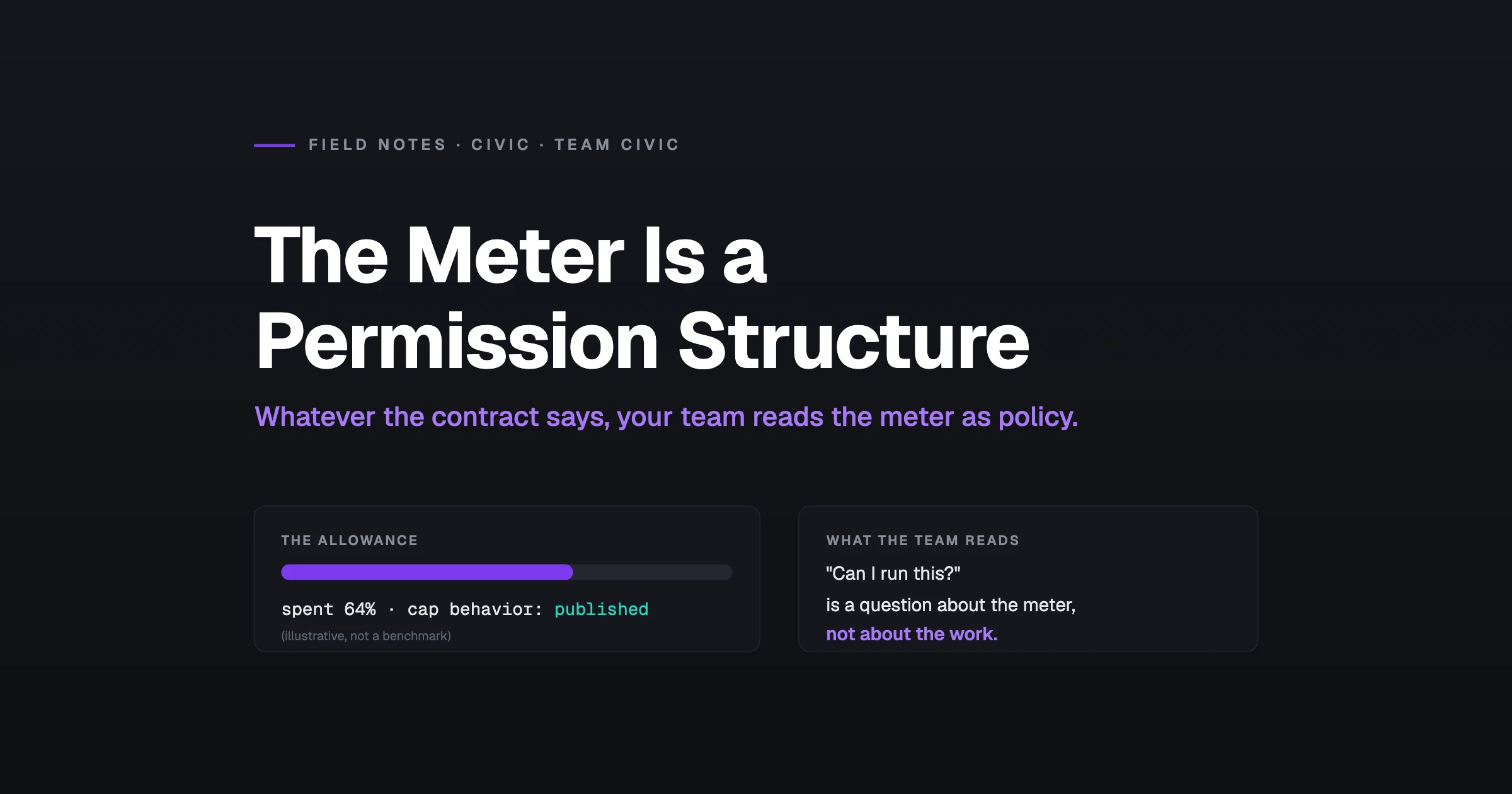
There is a scene playing out this week in most teams that bought agentic software this year. An operator has a run ready to go. It is the right run: the account is live, the moment is now. And they are sitting on it, because the run consumes an allowance somebody else owns, at a rate nobody can state, toward a cap whose behavior nobody has read.
Chris wrote on Tuesday about what vendors started counting, and buried in the buyer's argument was an operational one: "A meter isn't only a commercial instrument. It is a permission structure, and your team reads it that way whether or not you meant it to be one."
That sentence deserves its own note, because the meter conversation usually stops at procurement. The contract gets signed, the rate card goes in a drawer, and the meter goes on to run your team's behavior for the next two years.
Three properties, three behaviors
Strip Chris's three buyer questions to their operational form and you get three properties of a meter, each of which trains a behavior.
Unit legibility. Can the person taking an action state, in one sentence, what it costs? If yes, they spend judgment on whether the action is right. If no, they spend it on whether the action is affordable, which is a different question they are worse at answering.
Count visibility. Can the person spending the allowance see the live count, or does the count live in an invoice someone else reads at month-end? A visible count produces self-regulation. An invisible one produces two failure modes at once: the cautious operator who under-uses the tool, and the surprise overage from the one who didn't.
Cap behavior. Does everyone know, before it happens, what the tool does at the limit: stops, charges, or degrades? The teams that know run confidently right up to the cap. The teams that don't leave a safety margin whose width is set by anxiety rather than arithmetic.
What an illegible meter trains
None of this shows up in week one. It shows up as habits.
Hesitation first: the pause before every run that should have been reflexive. Then delegation upward: "can I run this?" questions arriving at whoever owns the budget, which converts a tool you bought for speed into a queue with an approval step. Then batching: saving up runs to spend the allowance deliberately, which is rational behavior and exactly wrong for a tool whose value is responding to moments while they are moments. And finally shrinking: running the smaller version of the job to be safe, permanently, until the smaller version is the job.
| Meter state | Behavior it trains |
|---|---|
| Unit legible · count visible · cap known | Run now. Judgment goes to the work; the run happens while the moment is a moment. |
| Unit legible · count visible · cap unknown | Batch it, shrink the job. An anxiety margin appears, and the smaller version of the job becomes the job. |
| Unit legible · count invisible · cap known | Ask first, batch it. Runs get saved up, and moments expire in the batch. |
| Unit legible · count invisible · cap unknown | Ask first, batch it. The invisible count dominates before the cap is ever reached. |
| Unit opaque · count visible · cap known | Ask first, shrink the job. The question goes upward and the job shrinks to be safe. |
| Unit opaque · count visible · cap unknown | Ask first, shrink the job. The opaque unit dominates. |
| Unit opaque · count invisible · cap known | Ask first, shrink the job. The opaque unit dominates. |
| Unit opaque · count invisible · cap unknown | Ask first, shrink the job. Every property is illegible; hesitation is the whole loop. |
All three legible: judgment goes to the work. The run happens while the moment is a moment. (illustrative, not a benchmark)
Behavioral outcomes illustrative, not a benchmark. The mapping is the argument, not a measurement.
The cruel part is what the renewal review sees: low usage. Both sides conclude the team didn't adopt the tool. Nobody in the room can see that the team adopted it fine and then trained themselves away from it, one ambiguous allowance at a time. Hesitation is a cost that never appears on the invoice it protects.