Field Notes/bryngtmagentsai-buyingaccountabilitygovernance
The AI Buyer Grew Up. Good.
The 2026 buyer wants to know what your agent delivered, how you can prove it, and what happens if it fails. With only 29% of companies reporting significant ROI from generative AI, that scrutiny is healthy.
Chris Hart, Chief Executive Officer
||13 min read|
tl;dr
The differentiating question in AI buying moved from capability to accountability. Serious buyers now ask what an agent delivered (pipeline, revenue, cost, risk), whether you can show the record, and how they leave. With only 29% of companies reporting significant ROI from generative AI, that scrutiny is healthy: it separates spending that performs from spending that is performative. We built Bryn assuming all three questions, because we would ask them too.
A market view on what changed in how companies buy AI, why the change is good for everyone who's serious, and what it means for how we built Bryn.
Ask an AI vendor what its product delivered last quarter.
Not what it can do. Not what's on the roadmap. What did it deliver in pipeline, revenue, cost, or risk mitigation?
Two years ago, that question rarely came up on a first call. Today, it often does. This is the best thing that has happened to this market since the models became good enough to use.
I'll be upfront about my lens. Civic builds Bryn, a Signal-Based GTM agent for Growth teams, and we encounter this new buying standard on nearly every call.
The differentiating question has moved from capability to accountability.
That change is overdue.
Productivity was enough for the pilot phase
When AI budgets first opened, productivity was the justification.
Hours saved. Drafts accelerated. Tickets deflected. That was the right measure for the moment. You can measure time saved inside a six-week pilot, and few companies had enough production data to connect an AI deployment to a broader financial result.
So productivity became the default language of AI value.
The buying motion was familiar. A champion ran a pilot. The pilot produced a time-savings estimate. The estimate went into a presentation. The presentation supported the renewal.
Nobody in that process was necessarily being dishonest. But the distance between the productivity slide and the P&L became where much of the disappointment accumulated.
The problem is simple: hours saved don't automatically become financial results.
A team that saves four hours a week has four hours. Whether those hours become revenue, margin, greater throughput, or simply longer meetings depends on everything surrounding the tool.
Where do the saved hours land?
Say a deployment saves your team about four hours per rep each week. Pick where those hours go.
~4 hrssaved per rep, per week (illustrative, not a benchmark)
RevenueOnly if the freed hours go to more selling motion that actually closes. Reaches the P&L.
MarginOnly if you do not backfill the freed time with new cost. Reaches the P&L.
ThroughputMore work shipped per head, but only if it relieves a real constraint. Reaches the P&L.
Longer meetingsThe hours get reabsorbed into the day. Never reaches the P&L.
Hours saved are an input, not a result. The P&L moves only if the hours land somewhere that counts.
Pick a destination (click or arrow keys). Same four hours; only some of them reach the income statement.
CFOs noticed. Boards noticed. Now the market is repricing AI around a harder standard.
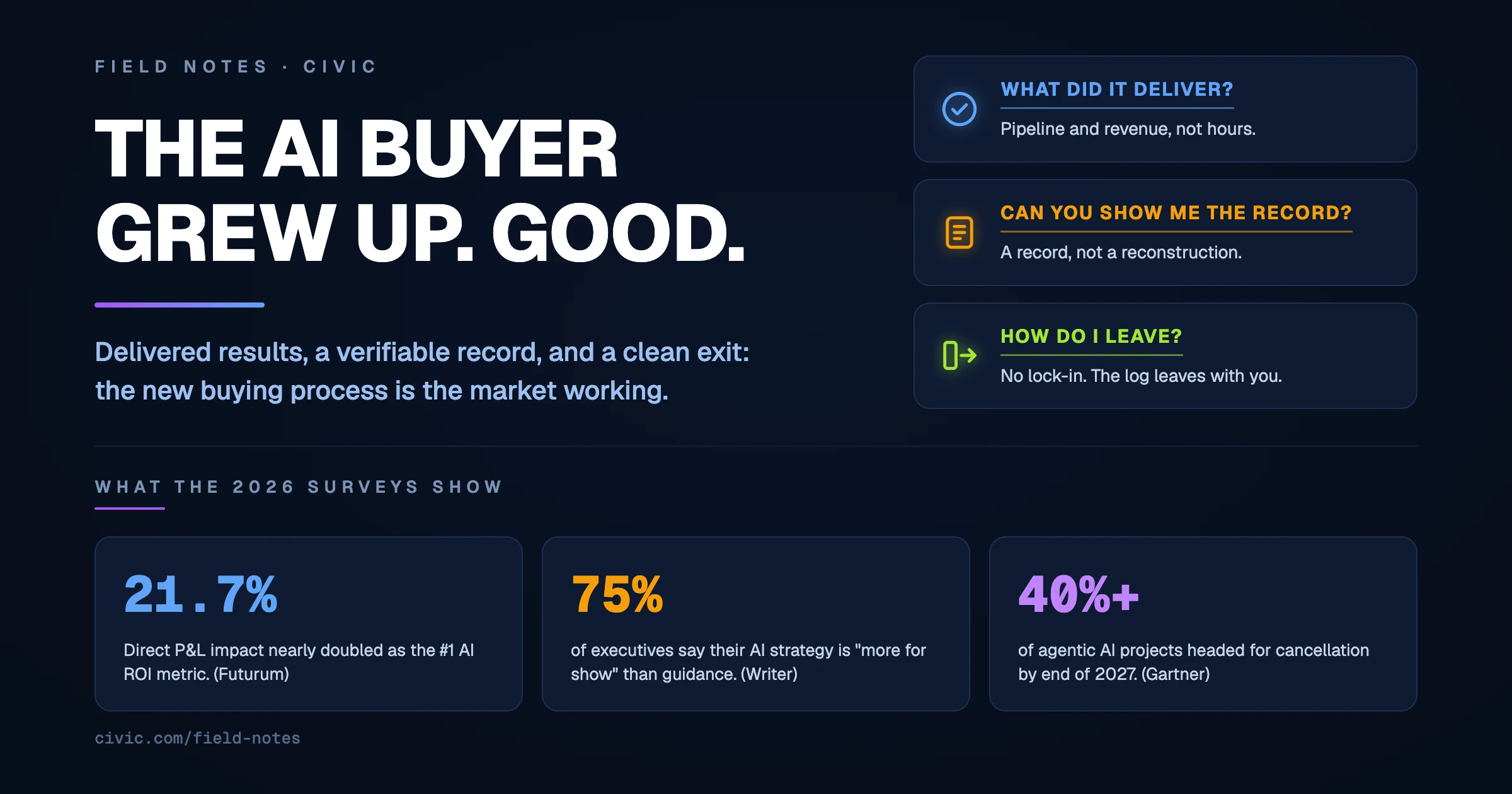
Futurum's 1H 2026 survey of 830 IT decision-makers found that productivity gains fell from 23.8% to 18% as the primary AI ROI measure. Direct financial impact, combining top-line revenue growth and bottom-line profitability, nearly doubled to 21.7% of primary responses.
Agentic AI also recorded the largest year-over-year increase among technology priorities, rising 31.5%.
Meanwhile, Gartner predicts that more than 40% of agentic AI projects will be canceled by the end of 2027, citing escalating costs, unclear business value, and inadequate risk controls.
Keith Kirkpatrick at Futurum put the vendor challenge plainly: sales teams that lead with "save four hours a week" are entering a losing conversation.
Read those numbers one way and the category looks shaky.
Read them another way and they describe a market doing what healthy markets eventually do: separating spending that performs from spending that is merely performative.
The skeptical buyer is good for agents
Start with what skepticism removes from the market.
On the supply side, existing software has frequently been relabeled as agentic without gaining meaningful agency. A chatbot becomes a copilot. A copilot becomes an agent. The underlying product changes less than the landing page.
Relabelling is cheap. Surviving "what happens when the workflow breaks, and who is accountable" is not.
On the demand side, when 75% of executives acknowledge that their AI strategy is partly for show, some portion of AI spending is clearly funding announcements rather than outcomes.
A buyer who demands verifiable business impact puts pressure on both sides.
A performative project struggles to survive a CFO asking what it delivered. A relabeled chatbot struggles to survive a diligence question about what happens when the workflow breaks.
Not every canceled project returns its budget to a better deployment. But some of that budget, attention, and internal political capital will move toward products that can attach a defensible number to their work.
That's the first-order effect.
The second-order effect matters more: skeptical buyers compound trust in the category.
Every agent that survives a serious buying process and then performs becomes a reference point that makes the next purchase easier. It makes the next purchase easier inside that company, and inside the companies its operators join later.
Categories don't earn permanent budget lines because vendors run good campaigns. They earn them because enough deployments hold up under scrutiny that finance stops treating them as experiments.
Cloud computing went through its own period of skeptical procurement before becoming standard infrastructure. Agents will have to earn trust through production results in much the same way.
This is a separate forecast from the prediction about canceled agentic projects, but the message is related. Business value isn't enough if an organization can't control, inspect, and correct the system producing it.
Buyers who ask about evidence, authority, and rollback before signing aren't being difficult. They're trying to avoid discovering a governance gap through a production incident.
That isn't fear of the technology. It's operational memory doing its job.
The strongest AI sales conversations in 2026 look less like product demonstrations and more like finance reviews.
Here's the claim.
Here's how you can check it.
Here's the record we'd hand your auditor.
Here's what happens if we're wrong.
Some vendors experience this as a downgrade, as though the craft has gone out of selling. We experience it differently.
This may be the first AI sales environment in which building the product correctly and selling it well are becoming the same job. Those haven't always been the same job in software.
It is good for everyone that they're converging.
In our own conversations, buyer skepticism tends to converge on three questions.
Three questions the 2026 buyer asks
The three questions, up close
Select a question. Each shows what the buyer wants to see, and what a vendor tells you by treating it as unreasonable.
Select a question (click or arrow keys). Model quality is table stakes; these three are where vendors separate.
What did it deliver?
Not usage. Not activity. Not a generalized claim about hours saved.
Which accounts? Which opportunities? What pipeline? What revenue? What cost? What risk was reduced?
The buyer wants a claim stated in the same units the business already uses, and one they can check against their own systems.
Productivity still matters. But productivity alone is no longer enough. The buyer wants to understand what the saved time, automated action, or improved decision produced.
Can you show me the record?
When the CFO, DPO, security team, or business owner asks what the agent did last Tuesday and who authorized it, is the answer a record or a reconstruction?
Evidence has moved from a compliance afterthought to a buying criterion.
The buyer wants to see the signal that triggered the action, the reasoning or rules that governed it, the systems the agent touched, the outcome, and the points at which a person retained control.
A summary generated after the fact isn't the same thing as a contemporaneous work record.
How do I leave?
What does leaving look like for the contract, the data, and the record of the work performed?
Enterprise buyers have already learned what software lock-in feels like. They now price that risk into the AI decision from the beginning.
They want to know whether they can export their data, preserve the audit history, disable the agent cleanly, and move without losing the institutional record of what happened.
These questions used to be treated as procurement friction, a phase sellers endured after the champion had already been convinced.
Now they are the buying process.
Most teams don't phrase the questions this cleanly, but some version of all three increasingly appears before the second call. Often it's an executive asking, not procurement.
Notice what's less likely to differentiate the vendor: a generalized claim that its model is good.
Model quality is increasingly treated as table stakes. Every vendor can claim intelligence. The differentiating questions have moved to accountability.
If you sell AI and these three questions frustrate you, the problem probably isn't the buyer.
What these questions changed in how we built Bryn
This month, we launched Bryn, the Signal-Based GTM agent for Growth teams.
Bryn watches signals across your product, website, and systems of record. It scores intent against your own definition of a good account, runs a Play you approved, and records every step.
We designed it with the assumption that serious buyers would ask all three questions, because we would ask them too.
What did it deliver?
Bryn turns signals you already own into prioritized, attributable actions designed to create pipeline.
Accounts showing live intent are identified where possible, scored against criteria your team defines, and acted on while the signal is still warm.
Instead of beginning the day by stitching together several dashboards and manually creating a queue, a Growth team can begin with the accounts Bryn identified, the signals behind them, the scores they received, and the actions already taken or held for review.
The claim is stated in pipeline terms.
More importantly, it can be checked. Every action traces back to an account, a signal, a score, and the Play that governed what happened next.
Can you show me the record?
Every Play Bryn runs writes its receipts as it works.
The signal that fired. The score. The Play that matched. Who approved it. Whether the action ran or was held. What happened next.
When your CFO, DPO, security team, or Growth leader asks what the agent did and under whose authority, the answer should be a record rather than a reconstruction.
That's why the audit log isn't an accessory to the product. It's part of the product's operating model.
It allows the business to examine the same work the agent performed, using the same underlying record.
How do I leave?
We designed Bryn so that customers can leave without losing the history of what happened.
Billing is available monthly, and the audit log is exportable at every point, including on the way out. The current terms are explained on our trial and pricing page.
Monthly billing is a stance, not simply a discount structure.
You should stay because the record proves the work is valuable, not because a contract makes leaving painful.
None of these capabilities was added after the fact to handle buyer objections. They're what building for the current buyer looks like when you treat attribution, evidence, and exit as design requirements.
If you're buying this year
Keep asking the three questions.
Hold every vendor to them, including us.
A vendor that treats attribution, evidence, or exit as an unreasonable request is telling you something about how the relationship may work after the invoice clears.
These questions won't eliminate every unsuccessful deployment. But they will filter out many of the projects most likely to fail because nobody established the outcome, control structure, or exit path before launch.
Bring your operators into the room too.
A Head of Growth, RevOps leader, security owner, or other hands-on operator will often know quickly whether a vendor's attribution claim can survive contact with your actual stack.
They know where the data is incomplete. They know which systems disagree. They know which workflows depend on someone manually carrying context from one platform to another.
Buying processes often go wrong when the economic buyer and the operator evaluate separately, then compare notes after the contract is signed.
Evaluate the business case and the operating reality together.
If you're building
Welcome the buyer who asks hard questions.
The same market correction canceling performative projects is concentrating spending on deployments that produce results and hold up under review.
That favors the teams that designed for attribution, evidence, control, and exit from the beginning.
The leverage in this market is no longer a better demonstration.
It's being the vendor whose claims survive checking.
The AI buyer grew up.
The vendors that matter will grow up with them.
If you're rethinking how you buy or sell in this market, I'd like to compare notes. Reply here, or find me at chris@civic.com.
Chris Hart is the CEO at Civic; he brings together decades of experience across technology, finance, and identity to help businesses navigate the shift to agentic AI. His Silicon Valley career spans more than 25 years, from running infrastructure at early internet and fintech startups to leading finance and operations teams at high-growth technology companies.
Beyond Civic, Chris has championed veteran leadership as Vice Chair of the Pat Tillman Foundation since 2006. When he isn't thinking about the future of identity and AI, you'll probably find him surfing or hanging out with his Dalmatian.